



Aug 24, 2026 6:29pm IST
Bharat Bala’s Virtual Bharat and the art of remembering India
There is an old Indian belief that a civilisation survives not because of its monuments, but because it remembers its stories. Over eons, stories continue to travel — from one generation to another, from one language to another, from memory into imagination. The question before India today is no longer whether these stories will survive. It is whether they will survive in forms that speak to a generation whose primary window to the world is no longer the printed page or even cinema, but the digital screen.
The evolution of Bharat
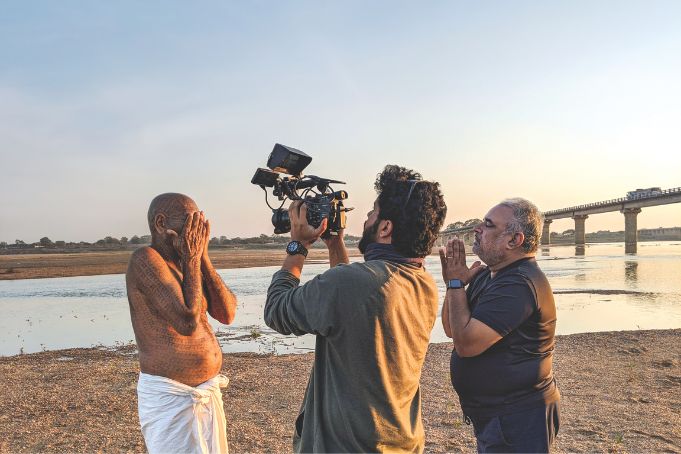
Filmmaker Bharat Bala’s Virtual Bharat enters the conversation as an act of cultural imagination. Through a 1,000 short films, interspersed with music and immersive audio-visual storytelling, the project aims to bring together voices that often exist “outside the frame.” The series, premiered in August 2019, feature under 10-minute films, spanning people, landscapes, literature, folklore, dance, music, traditions, architecture, and more. As this goes into print, Virtual Bharat received the National Award for Best Documentary for “Ram Nami” at the 72nd National awards, the first for the whole project.
For over three decades, Bala has grappled with one recurring question: how does one visualize India without reducing it to clichés? His work, from the iconic “Vande Mataram” collaboration with A.R. Rahman to documentaries and national campaigns, has consistently sought to locate the emotional grammar of the Republic rather than merely its geography. Virtual Bharat appears to be the natural evolution of that search.
The project seeks to preserve experience through the language of immersive technology. Imagine entering Nalanda before its libraries burned. Walking through the bustling markets of Vijayanagara before history turned them into ruins. Sitting beside Baul singers in Bengal, watching Manipuri dancers prepare backstage, listening to a weaver explain the mathematics hidden inside Banarasi silk, or accompanying scientists through the control rooms of India’s space programme — not as a passive viewer but as an active participant.
Related Stories

A living heritage
Around the world, nations are investing heavily in digital heritage. Ancient cities are being reconstructed through artificial intelligence. Museums are creating virtual exhibitions. Historic monuments are being scanned down to the smallest architectural detail. Yet much of this remains concerned with preserving structures. India’s greatest archive has always been intangible. It lives in oral traditions, seasonal festivals, folk music, ritual practices, local dialects, indigenous knowledge systems and everyday acts of craftsmanship. The challenge before any project attempting to represent India is therefore not merely technological, but philosophical.
Virtual Bharat will ultimately be judged not by the sophistication of its software but by the generosity of its imagination. Will India’s astonishing linguistic diversity find expression beyond subtitles? If the answer is yes, the project could become one of independent India’s most significant acts of cultural preservation. If not, it risks becoming yet another beautifully designed catalogue.
The timing of the initiative is particularly significant. Artificial intelligence, spatial computing and virtual reality are fundamentally altering how knowledge is produced and consumed. Children increasingly encounter history through interactive experiences rather than textbooks. Cultural diplomacy itself is changing.
South Korea exported a cultural wave through music and cinema. Japan transformed anime into an instrument of national imagination. India possesses something even older — a civilization that has continuously reinvented itself over millennia, but has often struggled to narrate its complexity in contemporary formats.
Educational implications
Technology, paradoxically, may now allow India to become legible to itself before it becomes legible to the world. The educational implications alone are immense. Imagine classrooms where students do not merely read about the Dandi March but walk alongside it; where the Ajanta murals can be examined centimeter by centimeter; where Takshashila, Mohenjo-daro or Hampi are not illustrations in a chapter but environments through which curiosity can wander. Learning ceases to be memorization. It becomes encounter.
What this project does
Technology itself guarantees understanding. Digital immersion can extend experience, but it cannot replace lived reality. To remind us that heritage is not something hidden behind glass but something continuously created by ordinary people. This is where Bharat Bala’s instincts as a filmmaker become particularly valuable. His cinema has rarely been interested in spectacle for its own sake. It has always sought emotional access. If Virtual Bharat succeeds, it will do so not because its graphics are photorealistic but because it understands that every civilization is ultimately held together by feeling.
India’s greatest challenge today is not the absence of history. It is the fragmentation of memory. Our conversations increasingly occur inside algorithmic echo chambers. Regional identities compete with national identities. Public discourse often reduces culture to politics and heritage to symbolism.
A project like Virtual Bharat, if built with intellectual honesty and cultural plurality, offers another possibility. It suggests that technology need not merely accelerate consumption; it can deepen reflection. It can become a space where India’s many stories converse rather than compete.
In the end, Virtual Bharat is not really about virtual reality. It is a shared inheritance of memories, voices, music, craftsmanship, landscapes and dreams. The digital medium may be new. The impulse behind it is as old as civilization itself: to remember who we are, and to ensure that those who come after us inherit not merely our monuments, but our imagination.
Vani Tripathi Tikoo is an accomplished actor and producer, and she is recognized as a prominent voice in cultural discussions at film festivals globally.




Comments are moderated. They may be edited for clarity and reprinting in whole or in part in Variety publications.