



Jul 15, 2026 7:45pm IST
Shubha Mudgal On Reimagining The Female Gaze Through Music And Poetry: ‘Women Were Not Published As Much As Men’ (EXCLUSIVE)
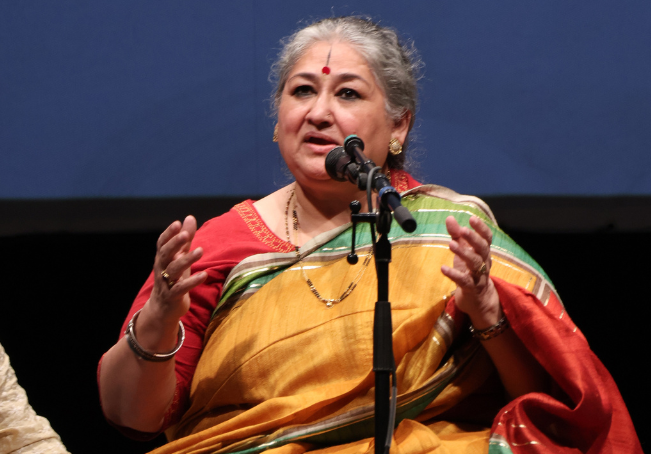
The historic Royal Opera House, Mumbai, alongside Avid Learning, will host ‘Women, Sexuality, and Song: Reimagining the Female Gaze in Classic Indian Poetry.’ Curated and performed by Shubha Mudgal, the evening offers a deep dive into Hindi literature and classical raagdari music. Presenting verses penned by Indian masters, Mudgal explores shifting perspectives on beauty, societal norms and the stigmas women have navigated across eras. Mudgal, in an exclusive interview to Variety India, speaks about the intricate layers of her upcoming performance and the broader socio-cultural challenges facing Indian classical music today.
The Musical and Literary Anchor
Balancing the celebration of romance with the complex subtexts of historical gender dynamics requires deep artistic discipline. For Mudgal, navigating these spaces is structured around her commitment to traditional Hindustani classical forms. She says, "Musically, of course, there are the parameters of the forms that I have been studying. My training is in raagdari music. Therefore, my work is largely anchored in raag-taal and in khayal and thumri-dadra."
This musical grounding is matched by an enduring relationship with literature inherited from her parents and gurus. "My parents were teachers of literature. My gurus were all vaagyakars [composer-poets] well versed in literature. My keen interest in literature, particularly in lyrical writing that can be sung, comes from those inheritances."
Related Stories


Unearthing the Silenced Female Gaze
The thematic core of the concert lies in exploring how gender and sexuality have historically been constructed in Indian poetry. Mudgal draws a contrast between male poets assuming the female persona and the harsh realities faced by women writers.
“In India, classic literature is written by male poets. They are able to talk of the female form and experience everything from the perspective of a woman. And then when you start looking at what women were writing about, it's also quite startling... women were really not published as much as men."
When published, women were typically restricted to writing devotional poetry of privilege. Exceptions like Praveen Rai, a 17th-century courtesan, provide a fascinating look into uninhibited historical expressions of desire. “She wrote with a certain freedom which I find very interesting," Mudgal highlights. "Scholars say there is a certain coarseness because of erotic elements, but I, as a woman today, find it very interesting that she was able to write with such freedom and with such lack of inhibition."
A Work in Progress at a Magnificent Venue
Mudgal has been expanding upon this specific theme for a decade. "This concert is a bit of a work in progress. I started working on this theme almost 10 years ago. Because the material I collect is quite large, no presentation is exactly the same... I make a selection based on how I juxtapose pieces together to make a statement," she shares.
Returning to the Royal Opera House, Mudgal values the venue team's willingness to embrace unconventional programming. "The space is magnificent," Mudgal says. "But more than the space, it's also the team... Where will I get a chance to sing about 'women, sexuality, and song'? The enthusiasm of the programming team is very encouraging."
The Complexities of Intellectual Property and Pedagogy
Beyond her vocal mastery, Mudgal is a key voice advocating for creators' rights and copyright awareness within traditional music circles. "Typically any student of Hindustani classical music is not trained about these issues," Mudgal reveals. "If I'm singing a composition written by Chandrasakhi ji, and if I don't mention that, it just becomes 'traditional.' This is a discussion which really needs to be discussed threadbare."
Mudgal also addresses the mainstream visual depictions of the Guru-Shishya relationship, which cinema frequently reduces to extreme physical suffering. "Not necessarily does every Guru insist on hardship," she reflects. "We can have conversations, we can agree to disagree... And yet we remain closely bonded."
Crossover Success and Cinematic Biopics
While Mudgal occupies a central space in classical circles, her iconic pop tracks like “Dholna” and “Ab Ke Sawan” remain embedded in India's broader sonic consciousness. She actively collaborates with younger, cross-genre producers. "I enjoy the collaboration and the interaction with other musicians, particularly when it's a form that I don't know much about," she smiles. "My role is to be a performer and what the artist wants to do thereafter is really their choice."
Regarding biographical films, Mudgal identifies a critical flaw in how Indian cinema handles musical legacies, often reducing human complexities to sanitized hagiographies. "We tend to put people on pedestals without treating them as human beings," Mudgal observes. "The story that is riveting for me is that this was a human being with an extraordinary gift, but a human being nevertheless."
A Universal Invitation
As the performance approaches, Mudgal remains firm that the core subject matter completely transcends generations. "The issue itself is universal. I don't think that there needs to be any age group distinction," Mudgal emphasizes. "The connections are made either through music, the literature, or through the general narrative... I'm ready to accept that (not every piece will be a favorite) because it's only when you try again and again that, otherwise, you know, I end up singing the same repertoire for the rest of my life."












Comments are moderated. They may be edited for clarity and reprinting in whole or in part in Variety publications.