



Jul 15, 2026 12:52pm IST
news-old-title
Punit Goenka on Building for the Future: ‘I Let Our Results Speak for Themselves’


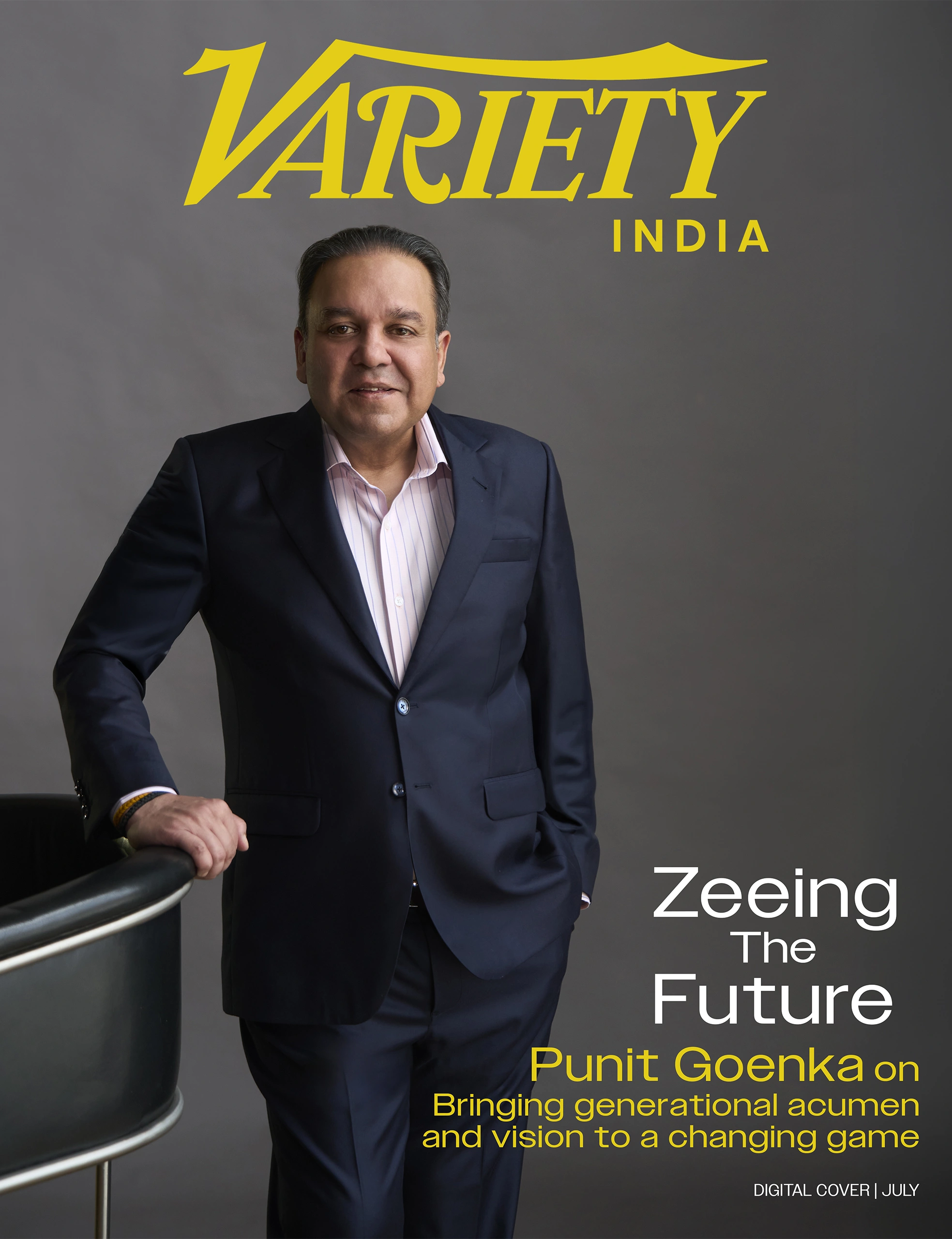
‘Building for the future’ is just the sort of philosophy one comes to expect from businesses led by the eternally forward-looking Punit Goenka, Chief Executive Officer, ZEE Entertainment Enterprises Ltd. Firmly in the driver’s seat, his vision has steered it and ‘Z’ ahead in the network race. Keeping a business of this scale as profitable as it has involves keeping growth engines (content and revenue) running at full-throttle. And with Goenka at the helm, network share has touched an all-time high of 18.2%. Flagship channel Zee TV has reached the leadership position in primetime. On the digital side, the most important growth story is about Zee5 turning profitable, making it the country’s only OTT platform in the green. But it is Z and Goenka venturing into new, strategic verticals like Bullet, KidZ, Zee Live, HiPi 2.0 and more, that underlines his strategy going forward.
In an insightful conversation with Variety India, Goenka talks about the exciting times in store for the media industry…
You continue to build a business your father started. Are your children inclined to do the same? What are the three of them up to?
Entrepreneurial spirit runs in our DNA. My wife Shreyasi and I are very proud of our daughter Anandini and our sons, Vivardhan and Udayan. They pleasantly surprise us with their unique abilities and talents. Anandini has already embarked on her entrepreneurial journey with Routed Media, where she is leveraging the potential of the creator economy and tech. I get to learn so much from her. Vivardhan has just completed his graduation in land economy from the University of Cambridge and aims to make it big in this field. Udayan, on the other hand, is a seasoned athlete and cricketer and maintains a very strong interest in the business of media and entertainment.
Would you be okay with them going in a totally different direction?
Absolutely. They are stepping into their respective professional journeys at a time when the opportunities are limitless, creativity is at its peak and tech is in its completely new persona. We will be even more proud if they carve out their unique paths to success and we are confident that they will.
The media industry is buzzing about ‘Z’. You have done something right to reach this position, what was the game plan?
I have never believed in creating too much noise about what we are trying to do and how we are scaling the business. So we have been quietly doing what we wanted to, and trying to expand the Company beyond the television business. We have built a well-diversified business portfolio and expanded into newer avenues with digital, new strategic initiatives, the sports business and more.
Related Stories
So all this time when you were quietly building and there was noise in the market, did it affect you at all?
No, I don’t let noise affect me because noise will always be there. We have to keep our heads down and keep working towards what we want to achieve. I don’t think you can control the noise, and there is no point in it. I let our results speak for themselves.
Do you want to share insights about the big football play?
It’s not just about football, it’s about building a robust sports business. Our entire game plan is to build a strong sports network. We are going to focus on building sports which are home-grown, which may go beyond the 600 million people who watch cricket, and may target a smaller segment. But we will aggregate all of them and reach 600 million. Football itself is an over 300 million people sport, so there is no reason we cannot build an alternate sports network. In fact, over and above the strategic partnership inked with FIFA for 8 years, we have also secured the broadcast and digital rights for the German football league – Bundesliga, for a period of 5 years.
‘Z’ network has reached 18.2% share, and Zee TV is maintaining a strong position in primetime viewing, even Zee 5 is showing profit. What is the secret behind this turnaround?
In fact our network share is at an all time-high of 20% and is increasing steadily. My people are the ones who are turning this around. This is the result of a new team built from within the organisation. We have not gone out and hired new people. We have empowered people who we believe can add value and moved them around. Like Raghavendra Hunsur, who is our Chief Content Officer. We have several people across the language markets with enough and more responsibilities. I think we have a good team, who once empowered and given the opportunity, will perform and deliver. They are driving our new content strategy, which has enabled us to fortify our presence in the linear ecosystem.
How involved are you with content? Does it excite you?
Yes, absolutely. I watch content all the time to ensure that the quality of storytelling is constantly maintained.
Do you watch content abroad to see what’s working, Korean shows for example?
Yes, of course I do. In fact, we do have Korean shows on Zee 5. We have not been able to crack the Turkish market yet, it is a bit expensive, but it’s a market we are considering. But certainly, we have to look at global content trends because at some point of time they will transcend into India as well. We are a brand that caters to the entire Bharat and not just one market, and that will be our focus going forward.
From a film perspective, Zee Studios is aggressively active again. What made you take a short break in this arena?
We wanted to view and understand the shifts happening in the industry and then decide our next steps. For instance, Dhurandhar is not my movie, but I appreciate what they have created. It is an excellent ode to the film industry. Not many people can make such a movie every time, but you can make good cinema and good content which will resonate with the audiences. That is what we were waiting for, and I believe we have a good slate now. We have expanded into various language markets, and across all our business verticals, we are replicating our success from the linear segment.
Is there a vision for cinema, do you want to take a particular route?
We will always remain a family-centric business across all our segments. Therefore, even in cinema, we will remain family-oriented. We want the entire family to come together and watch a piece of content, and that will remain our forte and focus.
How has competition changed for you over the years?
Businesses change because of the macro-economic situation. Competition has changed because of the consolidation that you may have seen. We have given tough competition to players earlier as well, and we continue to do so.
Does regaining market share become difficult when you want to explore new avenues?
When exploring new avenues, you are trying to gain market share but more importantly, you try to build a brand which can be consistent and people resonate with. So from that perspective, I think market share is a secondary point, my first point is what my brand stands for and if I am delivering that to the consumers or not.
There has been a major reshuffle even in Zee Music and you have a new team in place. There is speculation that music acquisition is at its peak now. The industry is talking about Zee Music acquiring the rights of King at a record price of Rs. 50 crore. Comment.
I don’t comment on pricing. We are in dialogue but nothing has been inked yet. At a macro-level, I think music is one of the most promising industries because music is evergreen, unlike other content which has limited shelf life. I keep telling people that the amount of overflows that Zee Music in its over 7-year existence has paid to the producers; collectively, no music company would have paid that kind of overflows. When we earn money, we love to share it.
In this years, how have you seen the music industry change?
The music industry has changed because it is consolidating and therefore, more number of people are competing for the top 10 movies. So the pricing is going all over the place, which in my view is not the right thing to do because eventually, it has to make commercial sense. The language markets are pretty much operating the way they always used to.
Do you feel there is too much stress on Bollywood music, whereas the younger generation is listening to totally different kind of music?
You will see new things in the music space coming from our portfolio. Depending on the consumers’ needs, we do invest time in film music across languages. Though I do believe that non-film music will also garner equal returns if not more.
What is the network’s plan for venturing into new formats or strategic verticals?
We have recently expanded into 4 new verticals. We have entered into short-form content, with Bullet, which we are building as a platform. We are also re-building the kids content space because we believe this is one segment that is being ignored completely. We have also expanded into the live business, because I believe that segment is huge and has immense opportunity, given the current dynamics. Currently, it is quite fragmented, there is no organised player. And fourth is Sports, which I have already spoken about.
We see nobody makes films for children anymore, despite being a big market.
We have to find the right kind of stories that will resonate with kids. The reason being, no one is doing enough research on what the kids want to watch. Once you know what they want to watch, you will understand what content you need to make.
You have always been a man with a vision, how are you strengthening your capabilities to build for the future?
Our vision is to continue focusing on building the business and find new opportunities to expand the business. It is not restricted to anything, wherever we find something that resonates with our audience and more importantly, is core to our business, we will consider it. That is the basic vision that I have, which is then backed by finding the right people to build the business with.
So in live, are you looking at concerts and sports events?
I am not so sure about sports events because those are largely controlled by the associations. But live events is definitely worth exploring and that is why we have expanded into this business.
Do you want to talk about what you see in the live events zone?
Everything that we do, while we will get talent from overseas and India, our large focus will be on creating our own IPs.
Zee boasts of immensely successful IPs, what is the way forward to explore newer avenue pathways for them?
It’s about how we can monetise the IPs further, whether by re-creation of content or licensing the IP to others. But I am very clear that we will never sell our IPs. That is the strategy and vision we are working with. Whenever I sit in content meetings, my first question is always around, if the IP is with us or not. Mostly, if the IP is not with us, I reject it. We are here in the long-term game and we are the largest owners of IP in the country today.
You have always thought out of the box, but the initiative to enhance content creation through an omni-channel approach across platforms, how is it working for you?
We always had an omni-channel approach because we were buying content across platforms. We lost it for some time, but we have now brought the strategic approach back. For the longest time, we have been buying content for multiple platforms and I expect it will bring us into the limelight of being more successful by having multiple rights across an entire gamut of segments – satellite, digital, music, and we can then monetise it that much better.
‘Z’ has major successes in fiction and non-fiction genres, how do you calibrate them across traditional and digital platforms. Where is the focus thrust?
We have had some hits. I am glad to say that our language strategy has paid off really well. We have seen massive success in the language markets and I hope my team replicates that in the Hindi markets as well. I am sure they are taking lots of efforts to get there and they should get there. They have gone from 16% to 18.6% network share, which is not a small feat and I am sure they will go higher than that.
What are the strides you have taken in AI, and in content?
We are studying AI and testing it largely on dubbing and parts of our content. I have seen some films that have been generated by AI. Honestly, I would not make it, because it doesn’t hold my attention, the human creative feel is missing. There is no real human emotion. At the end of the day, if a piece of content is not holding my attention, it is not of consequence. In Music creation, AI is working quite well. But in video, I am yet to see exceptional results. I have seen so much content in 22 years, that may be I have gotten used to a certain way of watching content, which is quite real.
Has the strategy changed or evolved when it comes to programming decisions across your channels?
Programming strategy follows purely based on how audience is evolving. So yes, programming strategy will keep changing. Today, the audiences have evolved quite a bit and the success of ‘Z’ is a result of understanding this change and catering to their preferences, because we pivoted to that model. Today, the audiences are fine to watch a bit of kitchen politics in shows, but they want a lot more of content that is framed outside the kitchen. So they like watching different stories. The underdog stories are no longer relevant.
Do you do a lot of data and research to find out what people are liking, how they are changing?
We do a lot of research and mining of data, but more importantly, I invest a lot of my time in visiting smaller markets and talking to audiences on the ground. Other than that, how do you understand what they want?
Content in India is vastly divided. While content on digital started with a different outlook, content on TV doesn’t seem to grow beyond a certain sensibility. What is the reason for that? When OTT started, they were very clear that they didn’t want to do what TV was doing, and now everyone is doing just that.
The answer is simple, the largest audience continues to be on TV. This audience prefers to watch a particular type of content and when certain (OTT) platforms showed niche content, they got a certain amount of viewership. But it didn’t go any further, so now they are trying to ape what TV was doing pan India.
Have TV shows also changed?
Significantly. The biggest change reflects in the various relationships being showcased. The family dynamics have evolved and TV shows reflect the same as a mirror. We pick up very small nuances which in my view, are very important.
More OTT platforms are now resorting to conventional content, do you feel they are missing out on the opportunity to create something unique by playing the safe card?
They are not playing the safe card, they are trying to ape the content that TV makes and they are spending more money on it. They can afford to do it because they are doing it for 10-12 episodes. When I am making 260 episodes, the economics are quite different.
‘Z’ weekly reach now exceeds 730 million, making it India’s No. 2 entertainment player. What do you attribute this to?
I attribute it to content. We have created only quality content across languages and therefore the reach is going up. Our business is all about content.
On the regional side, Zee Marathi continues to do phenomenally well. What do you attribute that to?
I largely attribute it to the fact that we brought back the old team that was very successful and they strengthened the entire channel. This is a country where, if one gets success, people do follow. It does dilute my market share as it gets split further, but that’s the way business is. It has happened even in Odia, Bangla and other language markets.
What are the network plans in other regional markets?
There are a few markets we are evaluating, we are already a 12-language network, making ‘Z’ the largest language network in the country. By next year, we will be in 14-15 language markets.
The channels make their own content or is it dubbed?
It’s a combination of both. When we launched Odia, we dubbed a lot of Bangla content but eventually we started making original content. We still have some dubbed content but prime time is purely original content.
Among the OTT platforms in India, profits are still far away. Zee 5 has reached break even and are you happy with it?
We are not competing from that perspective, we are fortunate to achieve this goal we had set 1.5 years back. But we still have a long way to go, because profitability also means sustainable growth in the long-term.
What are the strategies you adopted to reduce the losses in Zee 5?
We streamlined the Technology & Innovation Centre team. Similarly, because of the pricing, we focused on content besides mega films. So it was a combination of things along with effective sales and marketing coupled with a pricing strategy across monthly, quarterly and annual pack offerings. So multiple things were strategically implemented.
Do you think pricing of films have undergone correction?
Select films are still commanding a high price, but for the rest the prices are falling in place. Theatricals are still a very different market and it will take some time for it to settle down. The Dhurandhars and Gadars will be there, but they won’t be there every week.
How do you identify new growth avenues in a constantly evolving market, especially in a crowded market?
My vision is for the long-term. I believe in solving problems for the future, which will eventually help us reach our goals.
Direct to Digital films was a concept you tried with Radhe. Why didn’t you repeat it?
We were amidst the Covid-19 pandemic when we tried the strategy, which were different times. I believe it worked for us back then, as it got us a lot of subscribers at that point of time. The fact of the matter is that in a business environment, everything is dependent on that moment, when you are trying to do something. I am still open to the strategy as long as its commercially viable.
The younger audiences today have short attention spans. What is your take on that?
I see that all around me. Hence, we are building our own short-form content with Bullet as this will be a reality, it’s not a fad.
What are the new monetisation avenues you are looking to explore?
I think the new monetisation avenues are expanding the network to multiple formats such as sports and short-form content, then enabling us to cross-sell. There is one big segment that we have not yet explored fully, which is the influencer marketing segment. It is becoming huge by the day. As I said earlier, we will remain core to our business and will continue working around it.
What does the future hold for ‘Z’?
The future is going to be what we make of it.
What is your day like?
I wake up between 7:30-8:00 am, and I spend 30 minutes doing meditation. Then I head to the gym, and I work out before heading to office. I head home by 6pm, to continue with the virtual calls and meetings at home. I usually have an early dinner, though the day wraps up by 11 pm.
How many years ahead are you in your head business wise?
Our plans are in place till 2030, because the industry itself keeps changing so rapidly, one cannot plan beyond a certain period of time.
Comments are moderated. They may be edited for clarity and reprinting in whole or in part in Variety publications.