



May 27, 2026 3:00pm IST
“Art Should Be Allowed To Ask Difficult Questions”: ‘Mrs. Chatterjee vs. Norway’ Director Ashima Chibber (EXCLUSIVE)
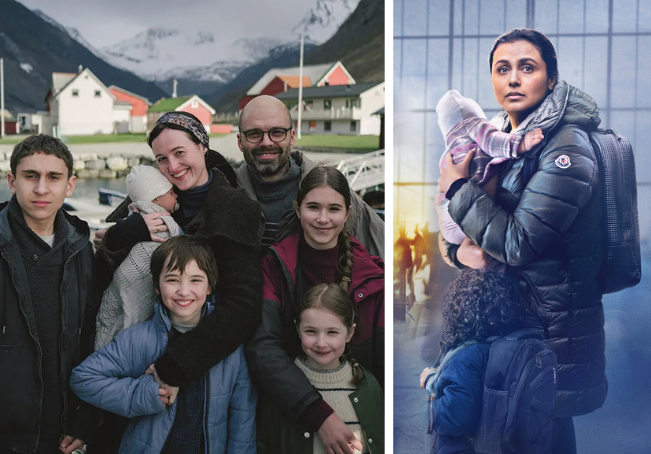
Cinema has a unique way of turning isolated, bureaucratic nightmares into universal human truths. In 2023, director Ashima Chibber shook the Indian diaspora with ‘Mrs. Chatterjee vs Norway’, a fiercely emotional, Rani Mukerji-led melodrama charting a mother's raw, agonizing battle against Barnevernet—Norway’s notoriously rigid child welfare agency. The film sparked massive national debate and even drew fierce pushback from the Norwegian Ambassador to India, who claimed it riddled the state system with factual inaccuracies.
Cut to 2026, and the global cinematic community has been forced to look at the exact same institutional mirror. Romanian auteur Cristian Mungiu’s latest feature, ‘Fjord’, just clinched the prestigious Palme d'Or at the Cannes Film Festival. Exploring a parallel nightmare—where a traditional Christian Romanian-Norwegian couple (played by Sebastian Stan and Renate Reinsve) has their children seized by secular progressive authorities, ’Fjord’ has brought the conversation around immigrant parenting, cultural alienation, and state overreach back into the international spotlight.
For Chibber, this sudden thematic overlap isn't just a trend; it is a profound artistic validation.
"It's a very good thing," Chibber says when asked about ‘Fjord’s’ monumental win at Cannes. "Culturally, when people are talking of the same anxiety, or the same insecurity of children being taken, or the same pain, that means the conversation is not about India—it is a universal conversation. Art should be allowed to ask difficult questions And ‘Fjord’ And ‘Mrs. Chatterjee vs. Norway’ is doing exactly that"
Related Stories

While Mrs. Chatterjee was rooted in the specific cultural shockwaves felt by an Indian family navigating the West, Chibber notes that the underlying trauma transcends borders. She points to other real-world international crises, to emphasize that these systemic clashes are a global reality.
"Even though I didn't win [the Palme d'Or], I feel that, yeah, I won it—because you have triggered a conversation," she reflects proudly. "And the fact that the film is called ‘Fjord’ says so many things. A fjord is heaven, isn't it? So, if it is so heavenly, then why are these parents suffering? Why are these kids being separated from their parents?"
While both ‘Fjord’ and ‘Mrs. Chatterjee vs Norway’ address the same institutional horror, their execution represents two completely different ends of the cinematic spectrum. Mungiu’s ‘Fjord’ is clinical, morally grey, and objective. Conversely, Chibber approached her film through a deeply empathetic, high-stakes Bollywood lens.
"The genre decides what will be the emotional content," Chibber explains. "I went for a mother’s human story because I felt that’s what interested me the most. You’re not going to think behavior, you’re not going to think laws in that moment. You’re going to think, ‘Get the kids back’, because that’s your basic core."
This human-first approach deliberately championed a mother’s perspective. When adapting the real-life story of Sagarika Chakraborty, Chibber resisted the urge to dwell heavily on the grey areas of parenting styles that a European art-house director might obsess over.
"When you’re taking a mother’s story, she’s not going to say, 'I’m bringing up my children wrong.' She says, 'Okay, maybe the styles are different. If you don’t want me to eat with my hand, I’ll eat with a fork.' The mother has given birth, so at any point, she’s not wrong."
Despite her film's emotional drive, Chibber maintains that she tried to strike a balance, pointing to Jim Sarbh's character in ‘Mrs. Chatterjee’, who represented a success story of the adoption system. "The systems of both countries are working," she concedes. "But out of the lot, I chose the mother's point of view."
She acknowledges that child protection services are undeniably vital—both in India, where child abuse remains a major crisis, and abroad. However, her criticism lies in the complete lack of cultural empathy and orientation for immigrant families moving to the West for a better life.
"Families are messy. People scream and shout. Kids throw things. Parents are triggered," Chibber argues. "[Immigrants] don’t know that they are not supposed to be sleeping with the children in the same bed—we don’t do that in India. Either you have an orientation like that and say, 'You're coming in with your children, these are the laws of our country.' People cannot guess."
With ‘Fjord’ set to dominate the upcoming awards season and ‘Mrs. Chatterjee vs Norway’ continuing its strong legacy, the commonalities between the two films is finally forcing a global reckoning.
Ultimately, Chibber views this cinematic intersection as a plea for cross-cultural empathy.
"I feel it is all about compassion," she concludes. "Are you understanding another culture? Are you understanding another mother? Are you understanding immigrant families and what they are facing when they are moving countries for a better life? This brings the conversation out... and it's a validation for all of us."












Comments are moderated. They may be edited for clarity and reprinting in whole or in part in Variety publications.