



Jun 10, 2026 5:30pm IST
Why ‘Disclosure Day’ And ‘E.T.’ Prove Hollywood Always Wins With Alien Blockbusters
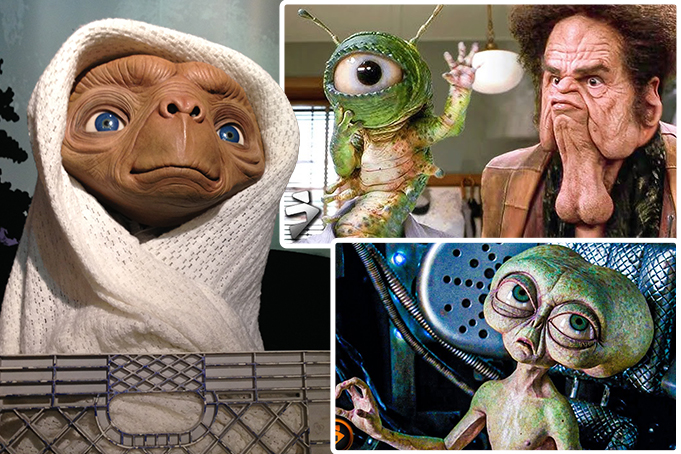
Right from the moment a boy and an extra-terrestrial drove a flying bicycle across a moonlit sky in “E.T.,” cinema captured a profound truth: we are obsessed with what’s out there. Cut to present day, and our fascination with flying saucers, cosmic anomalies and mysterious visitors has only grown more intense. While humanity has never come close to verifying a physical entity in person, cinema, a medium uniquely engineered to transcend boundaries, has continually brought us face-to-face with space creatures.
With the upcoming release of “Disclosure Day,” the cultural conversation is once again looking skyward. And looking back at Hollywood's financial history reveals that studios have already fully embraced the cosmic. For decades, aliens haven't just been a narrative device; they have consistently proven to be the biggest attractions, highest earners, and truest "stars" of the global box office.
The Ultimate Category Checklist
When charting the history of the extra-terrestrial box office, it is crucial not to get lost in adjacent genres. This isn't space opera or planetary fantasy like “Star Wars” or “Dune,” where humans navigate established cosmic societies. This category specifically spotlights the collision between humanity and the unknown—stories where extra-terrestrial life makes contact with Earth, or where unsuspecting humans stumble into an isolated alien nightmare. It spans from humanity's first peaceful cosmic interactions in “Close Encounters of the Third Kind” (1977) and Steven Spielberg's heartwarming “E.T. the Extra-Terrestrial” (1982), to the terrifying, isolated horrors of Ridley Scott's “Alien” (1979) and John Carpenter's shapeshifting nightmare “The Thing” (1982). It covers the massive global blockbusters that turned first contact into high-stakes blockbusters like “Independence Day” (1996), “Men in Black* (1997), and Steven Spielberg's relentless “War of the Worlds” (2005). Finally, it includes deeply atmospheric, thought-provoking encounters with the unknown, as seen in M. Night Shyamalan's eerie crop-circle thriller “Signs” (2002), Denis Villeneuve's linguistic masterpiece “Arrival” (2016), and the enduring philosophical warning of “The Day the Earth Stood Still” (1951 / 2008).
The "How" and "Why": The Allure of the Hot Ticket
Why do production houses and global distributors consistently pull out all the stops, allocating massive marketing campaigns and peak summer or holiday release dates to ensure these films get an explosive opening?
The answer lies in a rare combination of universal marketing appeal, high visual spectacle, and deep psychological resonance.
Unlike dialogue-heavy dramas or culturally specific comedies, the concept of a cosmic visitor requires zero translation. A massive shadow looming over the White House in “Independence Day” or a monolithic, silent vessel floating over a misty field in “Arrival” communicates instant, high-stakes narrative tension to an audience in Tokyo, Paris, or New York alike. It is a borderless concept built for massive international returns.
The Twin Pillars of Emotion: Wonder vs. Terror
Extra-terrestrial cinema successfully weaponizes the two most visceral reactions a moviegoer can have: absolute wonder and primal fear.
On one end, films like “Close Encounters of the Third Kind” and “E.T.” tap into our deep-seated human desire for connection, hope, and cosmic reassurance. On the flip side, Ridley Scott’s “Alien” or M. Night Shyamalan’s “Signs” exploit our terrifying fear of the dark, isolation, and predatory forces we cannot comprehend.
Both emotional tracks trigger an urgent, communal "need-to-see-it-on-the-big-screen" response that drives massive opening weekends.
By the Numbers: Cosmic Box Office Domination
The financial track record of these properties explains exactly why studio executives greenlight them with absolute confidence. The return on investment within this genre has routinely shattered industry expectations and set historic precedents, proving that the unknown is a goldmine. Take Steven Spielberg's “E.T. the Extra-Terrestrial” as the ultimate case study. Produced on a modest budget of just $10.5 million in 1982, the film went on an unprecedented theatrical run, capturing a staggering $797.3 million worldwide. It completely rewrote the history books, dethroning “Star Wars” to become the highest-grossing film of all time: a title it held proudly for a decade.
When studios scaled up the budgets, the alien genre proved it could scale its returns right alongside them. In 1996, 20th Century Fox bet $75 million on Roland Emmerich’s explosive disaster epic “Independence Day”. Driven by an iconic marketing campaign showing a spaceship obliterating the White House, the film took home $817.4 million globally. Not only did it become the highest-grossing film of its year, but it practically engineered the modern blueprint for the high-octane July 4th summer blockbuster tentpole that studios still mimic today.
Even when looking at more targeted or genre-blending entries, cosmic films consistently establish multi-billion-dollar empires. Ridley Scott’s original “Alien” was a masterclass in financial efficiency, turning a tense $10.7 million production budget into a massive $188 million worldwide haul in 1979. More importantly, that single movie spawned a continuous, highly lucrative cinematic universe that has pulled in billions across nine films, merchandise, and re-releases over four decades. Similarly, 1997's “Men in Black proved that the extra-terrestrial mythos could be crossed with sci-fi comedy, utilizing a $90 million budget to yield $589.3 million globally and launching a massive, multi-film global intellectual property.
Pitching the Unseen: How Directors Convinced the Suits
Today, a massive sci-fi blockbuster feels like a safe bet, but decades ago, convincing studio executives to hand over millions for movies featuring puppets, flashing lights, or hidden monsters was an uphill battle. It took visionary filmmakers utilizing profound psychological insights to get production houses to sign the checks.
When Steven Spielberg was trying to lock in funding for “Close Encounters of the Third Kind” Hollywood viewed UFO concepts as cheap, B-movie drive-in fodder from the 1950s. Spielberg completely flipped the pitch by focusing not on the monsters, but on the profound human psychology of looking at the stars.
As Spielberg later noted in an interview exploring his motivation: "From the behavioral science point of view, I was just as interested in finding out why people looked to the skies and wanted to believe, as I was in looking to the skies myself... If you believe, it's science fact; if you don't believe, it's science fiction. I'm an agnostic between the two beliefs, so for me it's science speculation. It's not ten light years away, it's right in the heart of American suburbia."
By grounding the extra-terrestrial experience in the middle of everyday, relatable suburban life rather than distant galaxies, Spielberg convinced Columbia Pictures that this wasn't a niche space movie: it was a deeply human drama that just happened to feature cosmic visitors. The gamble paid off, pulling in over $300 million worldwide in 1977 and saving a then-faltering studio from bankruptcy.
Years later, Ridley Scott utilized an entirely different, brilliantly brief pitch to get 20th Century Fox to aggressively back “Alien”. Rather than drowning executives in complex world-building lore, he delivered a lethal, high-concept elevator pitch that instantly communicated its commercial viability: It's “Jaws” in space.
The studio immediately understood the assignment. They knew the terrifying grip “Jaws” had on global audiences, and by transposing that exact primal dread into the claustrophobic vacuum of a spaceship, they knew they had a guaranteed goldmine.
The Undying Aura
“Disclosure Day” arrives on a path thoroughly paved by decades of cinematic brilliance. Production houses will always chase the extra-terrestrial because the genre offers a mirror to humanity unlike any other. Aliens remain the most enduring, versatile, and profitable stars Hollywood has ever known. They command our attention, capture our imagination and above all else, keep the box office registers ringing across the globe.


















Comments are moderated. They may be edited for clarity and reprinting in whole or in part in Variety publications.