


May 26, 2026 9:58am IST
Cannes or Couture? How the World’s Greatest Film Festival Became a Red Carpet Marketplace (GUEST COLUMN)
For decades, the Cannes Film Festival represented cinema at its most uncompromising , a sanctuary for auteurs, dissidents, political storytellers, experimental filmmakers, and cinematic risk-takers. This was the festival that elevated the moral gravity of Ingmar Bergman, the humanism of Akira Kurosawa, the political courage of Costa-Gavras, the social realism of Ken Loach, and the formal audacity of Andrei Tarkovsky.
This is the festival that embraced “Taxi Driver,” “Apocalypse Now,” “The Piano,” “Pulp Fiction,” “Parasite,” “The Tree of Life,” “Rosetta,” “4 Months, 3 Weeks and 2 Days,” and “The Wind That Shakes the Barley,” films not built for algorithmic virality but for artistic permanence, political confrontation, and emotional reckoning.
And for India too, Cannes once symbolised something far deeper than fashion spectacle. It was a site of cinematic legitimacy. A place where Indian filmmakers sought not visibility alone, but artistic dialogue with world cinema. This was the Cannes associated with Satyajit Ray, whose humanist cinema became part of the global cinematic canon. With Mrinal Sen and Ritwik Ghatak, whose political and formally radical storytelling shaped generations of filmmakers worldwide. It was the Cannes that recognised the parallel cinema movement led by filmmakers such as Shyam Benegal, Adoor Gopalakrishnan, Govind Nihalani, Girish Kasaravalli, and Aravindan Govindan , filmmakers deeply invested in social realism, political complexity, and cinematic experimentation.
This was also the Cannes where Mira Nair brought “Salaam Bombay!” to international acclaim, where Anurag Kashyap emerged as a disruptive independent voice, where Payal Kapadia restored attention to intimate, meditative Indian storytelling, and where films by Neeraj Ghaywan, Ritesh Batra, and Karan Kandhari signalled that Indian cinema could exist beyond spectacle and commercial formula. Cannes was never merely an event. It was cinema’s parliament.
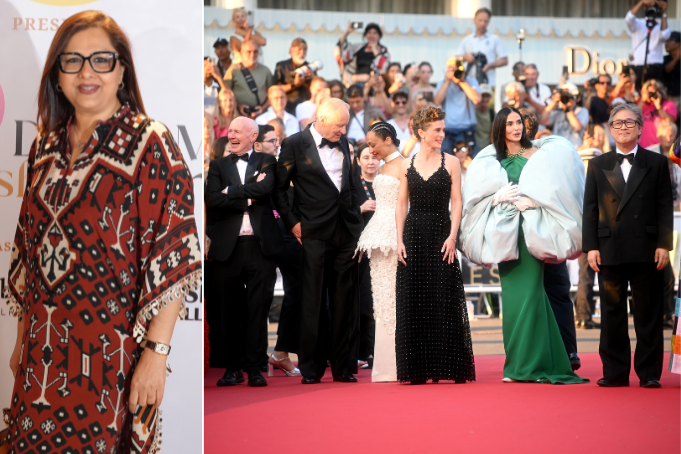
Today, however, much of the world encounters Cannes not through films, criticism, masterclasses, or artistic debate , but through luxury branding, influencer activations, couture breakdowns, beauty partnerships, and meticulously engineered social media spectacle. The shift is impossible to ignore. The modern Cannes ecosystem increasingly functions like a luxury marketing ecosystem wrapped around a film festival. The red carpet has transformed from ceremonial celebration into commercial inventory. Every staircase ascent is a campaign. Every photograph carries brand architecture. Every appearance is calibrated for digital circulation.
Related Stories

Fashion has always belonged at Cannes. Cinema and style have long shared a mutually seductive relationship. But Cannes was once about what happened inside the screening halls. Today, global coverage disproportionately revolves around what happens outside them. The irony is profound. While filmmakers inside the Palais grapple with war, displacement, class violence, censorship, identity, migration, memory, and democratic collapse, outside, timelines explode with jewellery close-ups, gown dissections, sponsored beauty routines, and influencer “Cannes diaries.”
One world wrestles with humanity. The other sells aspiration. The Cannes of serious cinema is built on difficult conversations and artistic danger. This is the festival that repeatedly opened space for politically charged cinema from Iran, Palestine, Latin America, Eastern Europe, Africa, and Asia. It celebrated filmmakers such as Abbas Kiarostami, Michael Haneke, Asghar Farhadi, Nuri Bilge Ceylan, Bong Joon-ho, and Ruben Östlund, directors who interrogate power, morality, capitalism, violence, and human fragility. Cannes has historically championed cinema that unsettles audiences rather than flatters them. Yet increasingly, that legacy is being overshadowed by a parallel economy of visibility. Nowhere is this more visible than in the Indian entertainment ecosystem.
Indian engagement with Cannes once carried aspirations of cinematic legitimacy and artistic recognition. The conversation revolved around films finding global audiences, auteurs entering international discourse, and independent voices claiming space in world cinema. Today, much of the coverage resembles fashion reporting with cinematic branding attached. Which actor attended? Which beauty label sponsored the appearance? Which influencer walked the carpet? Which couture house styled whom? Questions about screenings, acquisitions, critical reception, director conversations, cinematography, production markets, or independent film breakthroughs frequently struggle for comparable visibility.
The red carpet has become the headline. Cinema has become supporting material. Luxury brands understand the value proposition perfectly. Cannes offers a uniquely powerful blend of celebrity legitimacy, cultural prestige, exclusivity, and digital virality. Beauty conglomerates, jewellery houses, couture labels, hospitality sponsors, and influencer agencies all leverage the festival as a global branding arena. And media ecosystems willingly amplify it. The contemporary entertainment news model rewards optics over analysis. A nuanced political drama from Eastern Europe cannot compete, algorithmically, with a viral couture montage. A director discussing state repression attracts less engagement than a celebrity’s sponsored makeup reveal.
This is not merely harmless glamor culture. It changes how audiences understand cinema itself. Young audiences increasingly consume Cannes as an aspirational lifestyle carnival rather than as the world’s most important platform for artistic cinema. The mythology of filmmaking is gradually replaced by the mythology of access, luxury, and visibility. The collateral damage falls hardest on independent cinema.
Many filmmakers arriving at Cannes have spent years assembling fragile financing, confronting censorship regimes, surviving precarious production conditions, and betting their livelihoods on deeply personal work. Yet their films often disappear beneath mountains of sponsored content produced by personalities with little connection to cinematic practice beyond commercial collaboration. One could argue that this is simply the unavoidable evolution of the digital era. But evolution is not the same as surrender. When the discourse around Cannes prioritises skincare partnerships over screenplay innovation, brand ambassadors over breakthrough filmmakers, and luxury optics over cinematic ideas, something foundational has shifted.
Trade publications once centred their Cannes reporting around criticism, acquisitions, auteurs, production deals, aesthetics, and ideological debates shaping world cinema. Today, timelines overflow with arrivals, departures, yacht soirées, brand dinners, gifting lounges, after-parties, and “best dressed” rankings. Cinema criticism increasingly competes with lifestyle content masquerading as cultural reporting. And perhaps that is the deepest contradiction.
Cannes still showcases extraordinary cinema. Important films still premiere there. Political cinema still survives. New cinematic languages still emerge within its programming. But public attention is increasingly captured not by the films Cannes was built to honour, but by the commercial spectacle that surrounds them. The problem is not glamor. Cannes has always possessed glamor. The problem is hierarchy. There was a time when glamor orbited cinema. Today, cinema increasingly appears forced to orbit glamor and, more dangerously, the brands underwriting it.
Vani Tripathi Tikoo is an accomplished actor and producer, and she is recognized as a prominent voice in cultural discussions at film festivals globally












Comments are moderated. They may be edited for clarity and reprinting in whole or in part in Variety publications.