



Oct 16, 2026 10:46am IST
‘Whalefall’ Review: Austin Abrams Dives Deep, But The Film Strains To Stay Afloat
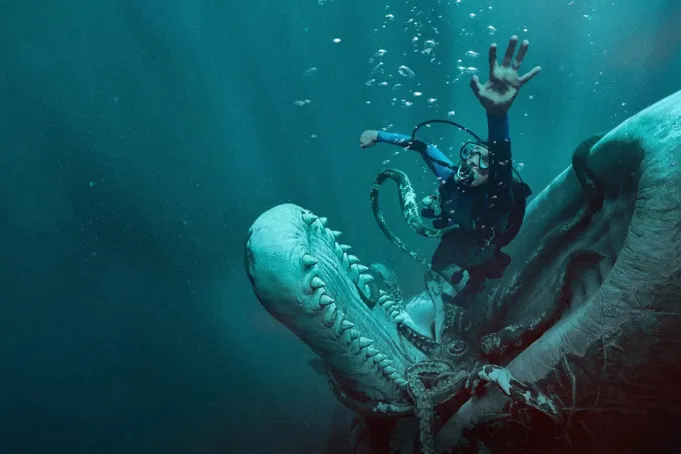
There are survival thrillers that leave you biting your nails, wondering how the protagonist will make it out alive. Then there is “Whalefall,” which might leave you wondering how many stomachs a whale has, what its larynx does and whether you accidentally signed up for a marine biology class. There is an ambitious concept here, but whether you have a whale of a time depends largely on how much patience you bring along.
Directed by Brian Duffield, Whalefall follows Jay Gardiner (Austin Abrams), a scuba diver who ventures into the ocean off California's Central Coast to recover the remains of his deceased father, Mitt (Josh Brolin). Jay's mission takes a disastrous turn when he is swallowed by a massive sperm whale. With his oxygen supply running out, he must figure out how to escape the enormous creature before he becomes part of its food chain.
Sounds like a nightmare, doesn't it? Unfortunately, the film's biggest problem is that it doesn't make the nightmare feel nearly as terrifying as it should.
Related Stories

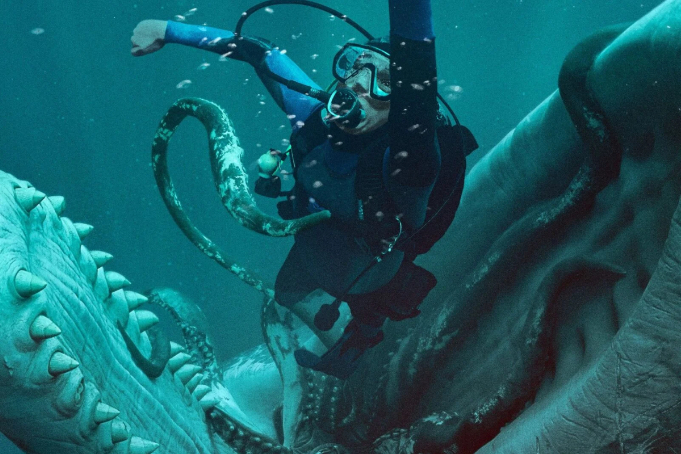
The premise promises a claustrophobic, edge-of-your-seat experience. After all, there are few situations worse than being trapped inside a whale with a limited supply of oxygen and no obvious way out. Yet, despite the increasingly bizarre situations Jay encounters, the sense of danger never quite gets under your skin.
The film deserves credit for the effort that has gone into recreating the whale's insides. The visual effects and sound design make its anatomy feel convincing, giving audiences an unusual glimpse into a world most of us would never want to visit in person.
But looking convincing and feeling frightening are two very different things. For a film built around a man fighting to stay alive inside a giant marine mammal, “Whalefall” surprisingly struggles to make you feel the walls closing in. The danger is evident on paper, but the tension doesn't consistently translate to the screen. You know Jay is in trouble. You just don't always feel it.
When a survival thriller fails to make you worry about whether its protagonist will survive, that's a rather large problem.
What “Whalefall” seems more interested in exploring is the relationship between Jay and his father. Mitt was a complicated man, and his relationship with his son was far from ideal. There is a sense of hurt between them, particularly because Jay wasn't there for his father when he needed him most.
Yet, as Jay struggles to find a way out of the whale, he repeatedly draws on the lessons Mitt taught him. At different points in his ordeal, memories of his father offer him the knowledge he needs to tackle the next obstacle. It is a neat way of bringing their fractured relationship into the survival narrative, showing how a parent's influence can endure even when the relationship itself has been damaged.
There is an interesting contradiction here, too. Jay may have unresolved issues with his father, but when his life is on the line, he still finds himself relying on the old man's wisdom. The film wants us to understand that love, resentment and grief can exist together, and that the people who hurt us can still leave us with something valuable.
It's a worthwhile idea, and Josh Brolin brings the necessary weight to Mitt. However, the emotional material doesn't always make the survival sequences more compelling. Instead, the film can feel as though it is pausing its thriller to deliver a philosophical lecture about fatherhood, grief and the complications of moving on.
Abrams is perfectly serviceable as Jay, carrying much of the film through a physically demanding ordeal. He conveys the struggle of a man trying to think his way out of an increasingly desperate situation, but the performance doesn't quite elevate the material beyond what is required of him.
Brolin, meanwhile, does a decent job as the difficult, emotionally complicated father whose lessons become central to his son's fight for survival. Their relationship gives the film its emotional foundation, even if the writing doesn't always make the most of it.
The film's title, however, is perhaps its most poetic element. A whale fall refers to what happens when a whale dies and its body sinks to the ocean floor, where it becomes a source of nourishment for an entire ecosystem. The idea of death giving life to other organisms is a fitting metaphor for a story about grief, legacy and the possibility of finding a way forward after loss. It is a thoughtful concept, and the title captures the film's deeper intentions rather beautifully.
Unfortunately, a good metaphor cannot do all the heavy lifting.
Whalefall isn't an outright disaster, nor is it the extraordinary survival thriller its premise suggests it could be. It has some impressive technical work and an interesting emotional idea at its center, but the suspense never reaches the intensity the story demands. By the time the credits roll, you may appreciate what the film was trying to say without feeling particularly moved or thrilled by the experience.

















Comments are moderated. They may be edited for clarity and reprinting in whole or in part in Variety publications.