



Oct 02, 2026 3:26pm IST
The Mahatma in Motion: How Indian Cinema Keeps Reimagining Gandhi
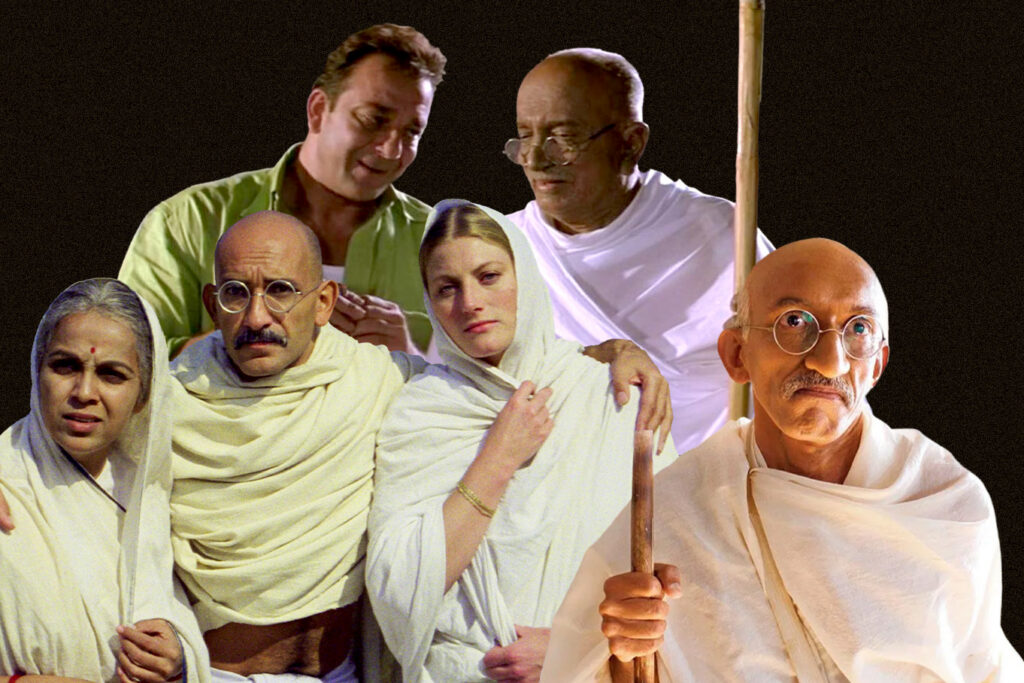
Few figures in Indian history have travelled through cinema quite like Mahatma Gandhi. He has been reconstructed through archival footage, played by actors from Ben Kingsley to Rajit Kapur and Naseeruddin Shah, placed inside stories about Ambedkar and Patel, transformed into a moral guide for a Mumbai gangster and examined through the eyes of his own son and grandson. No story of fight for the freedom is complete without Gandhi.
Currently, Sudhir Mishra is preparing another screen interpretation, with Manoj Bajpayee playing Gandhi. The yet-to-be-titled film, produced by Anubhav Sinha and presented by Narendra Hirawat’s NH Studioz, focuses on a lesser-known 21-day chapter during India’s transition to independence. Saurabh Shukla is also part of the cast.
Mishra’s film centres on a moment when the country was moving towards freedom. Delhi was emerging as the centre of political power, yet Gandhi chose to walk away. The filmmaker has defines that decision not as a retreat but as a moment of reinvention, allowing the film to explore the personal journey behind a familiar historical event.
The choice of such a narrow window is telling. Gandhi has been portrayed so often that another cradle-to-assassination biopic would inevitably have to contend with the versions that came before. Mishra instead appears to be looking for the spaces between the familiar historical milestones. And that has, in many ways, been the story of Gandhi on screen.
Related Stories
The Mahatma as historical record
Vithalbhai K. Jhaveri’s “Mahatma: Life of Gandhi, 1869–1948” remains one of the most extensive documentary attempts to chronicle Gandhi’s life. Released in 1968, the black-and-white documentary combines archival footage, photographs, animation and historical prints. Its longest English version runs for more than five hours and the narrative draws extensively from Gandhi’s own words.
“Nine Hours to Rama,” released in 1963, took a radically different route. Directed by Mark Robson, the British-American film compresses its story into the hours leading up to Gandhi’s assassination and follows Nathuram Godse. Gandhi is therefore less a conventional protagonist than the historical figure toward whom the entire narrative is moving.
Then came the international landmark. Richard Attenborough’s “Gandhi” (1982), with Ben Kingsley in the title role, offered an expansive account of Gandhi’s life, from his years in South Africa through the Indian independence movement to his assassination. The film won eight Academy Awards, including Best Picture, Director and Actor, becoming the most globally recognised cinematic portrait of the Mahatma.
Before the Mahatma became an icon
Shyam Benegal’s “The Making of the Mahatma” (1996) deliberately narrowed the lens. Based on Fatima Meer’s book “The Apprenticeship of a Mahatma,” the film concentrates on Gandhi’s 21 years in South Africa. Rajit Kapur played the young Gandhi, tracing his transformation from barrister to political leader. Kapur won the National Film Award for Best Actor for the performance. Its distinction was in treating Gandhi not as a finished legend, but as a work in progress.
Gandhi on the stage
Gandhi’s many interpretations did not begin with cinema. Indian theatre has repeatedly used him to examine the man behind the icon, his family and the ideas he left behind.
“Mahatma vs Gandhi”, based on Ajit Dalvi’s “Gandhi Virudh Gandhi”, focused on Gandhi’s troubled relationship with his eldest son Harilal. Feroz Abbas Khan’s production later became a key reference point for his 2007 film “Gandhi, My Father”.
“Mohan’s Masala”, written by Ishan Doshi and directed by Manoj Shah, looked at Gandhi before he became the Mahatma, while “Pehla Satyagrahi” traced his evolution as a political leader through his years in South Africa and India.
“The Prophet and the Poet” explored Gandhi’s intellectual exchanges with Rabindranath Tagore, particularly their differences over nationalism, education and the freedom movement. “Bapu” turned towards Gandhi’s final months, while Makrand Deshpande’s “Gandhi” used the Mahatma’s life and philosophy as a starting point for a contemporary, introspective solo performance.
The approaches were different, but the impulse was similar: to move Gandhi away from the frozen image of the Mahatma and find the man, thinker, father or political figure within it.
Gandhi as part of someone else’s story
Gandhi has frequently appeared in films where he is not the central character. Ketan Mehta’s “Sardar” (1993), about Vallabhbhai Patel, featured Annu Kapoor as Gandhi, placing him within the political tensions of the independence movement.
Jabbar Patel’s “Dr. Babasaheb Ambedkar” brought Gandhi into the story of B.R. Ambedkar, played by Mammootty, with Mohan Gokhale portraying Gandhi. Their ideological differences form part of the film’s larger examination of the political and social forces shaping modern India.
Kamal Haasan’s “Hey Ram” (2000) moved into fictional territory. Set against the communal violence surrounding Partition, the film follows Saket Ram, played by Haasan, as he is drawn toward a plot to assassinate Gandhi, portrayed by Naseeruddin Shah. Its unusual perspective makes Gandhi part of a story about hatred, radicalisation and moral transformation rather than a conventional biographical subject.
When Gandhi became pop culture
If Attenborough monumentalised Gandhi, “Lage Raho Munna Bhai” (2006) made him contemporary. Rajkumar Hirani’s comedy-drama brought Dilip Prabhavalkar’s Gandhi into the life of a Mumbai gangster. The character becomes Munna’s moral guide, allowing the film to translate ideas associated with Gandhian philosophy into everyday situations.
The result was “Gandhigiri": a pop-cultural shorthand for applying nonviolence and truth to modern problems.
“Maine Gandhi Ko Nahin Mara” (2005), starring Anupam Kher, took a more psychological route. Kher plays a retired professor who, while suffering from dementia, becomes convinced that he killed Gandhi. The film uses memory and the protagonist’s psychological state to explore the fading presence of Gandhi’s values in contemporary society.
The Mahatma as a father
“Gandhi, My Father” (2007) moved the camera into Gandhi’s family. Directed by Feroz Abbas Khan, the film focuses on his difficult relationship with his eldest son, Harilal Gandhi, played by Akshaye Khanna. Darshan Jariwala played Gandhi and won the National Film Award for Best Supporting Actor.
Its significance was that Gandhi’s public legacy became the backdrop to a deeply private story: the relationship between a father consumed by a national mission and the son struggling to find his own place beside him.
The final chapter
Gandhi’s assassination has produced another group of films that treat January 1948 as a story in itself. “The Gandhi Murder” (2019) approaches the final days through a conspiracy-thriller framework, dramatising the events surrounding his death.
“Why I Killed Gandhi” (2022), starring Amol Kolhe as Nathuram Godse, centres on the arguments Godse presented to justify his actions.
“Gandhi Godse – Ek Yudh” (2023) goes into outright alternate history. It imagines Gandhi surviving the assassination attempt and subsequently meeting Godse in prison, turning their ideological confrontation into the film’s central premise.
When Gandhi becomes an idea
Other films have used Gandhi without making him their principal subject. “Road to Sangam” places Gandhi’s legacy at the centre of a story about a Muslim mechanic repairing a vehicle associated with Gandhi’s ashes, using the premise to examine communal harmony.
“Dear Friend Hitler” imagines Gandhi corresponding with Adolf Hitler, creating a fictional dialogue between two radically opposed approaches to political power and violence.
“Koormavatara,” Girish Kasaravalli’s Kannada film, takes Gandhi’s image into contemporary fiction. An ordinary government employee who resembles Gandhi is chosen to portray him in a television serial, and the experience gradually affects his own behaviour and values. The film won the National Film Award for Best Feature Film in Kannada.
Gandhi in the streaming age
Long-form storytelling has opened another route into Gandhi’s life. Hansal Mehta’s upcoming “Gandhi,” starring Pratik Gandhi, is based on Ramachandra Guha’s “Gandhi Before India” and “Gandhi: The Years That Changed the World.” The series is planned across three seasons, giving the story room to examine Gandhi’s formative years and political evolution at a scale unavailable to a conventional feature.
“Freedom at Midnight,” created and directed by Nikkhil Advani and based on Larry Collins and Dominique Lapierre’s book, takes a different approach. Chirag Vohra plays Gandhi alongside Sidhant Gupta as Jawaharlal Nehru and Rajendra Chawla as Sardar Patel.
The series moves through the political negotiations surrounding independence, Partition and the violence that followed, placing Gandhi within a larger ensemble of historical figures rather than making him the sole centre of the story.
And now, Manoj Bajpayee’s Gandhi
That brings the cinematic Gandhi back to Sudhir Mishra. The filmmaker is not attempting to compress an entire life into another familiar biographical arc. His untitled film is built around 21 days during the independence period, a moment when Delhi was emerging as the centre of political power, while Gandhi chose to move away from it.
For Manoj Bajpayee, it is also a career first: he will portray Gandhi on screen for the first time. The project therefore arrives not as another attempt to establish who Gandhi was, but as another attempt to ask what a particular moment in his life meant.
That is perhaps why Gandhi continues to return to cinema. The dates are history. The arguments are not. Every generation of filmmakers find their version for Gandhi, and then put him back on screen. Because the historical Gandhi may be fixed in photographs, textbooks and archives. The cinematic Gandhi is not. He changes with the questions filmmakers bring to him.






Comments are moderated. They may be edited for clarity and reprinting in whole or in part in Variety publications.