



Nov 08, 2026 9:00pm IST
Mahesh Bhatt on Theatre: ‘I Am Fascinated by What an Actor Can Do Before a Live Audience’ (EXCLUSIVE)
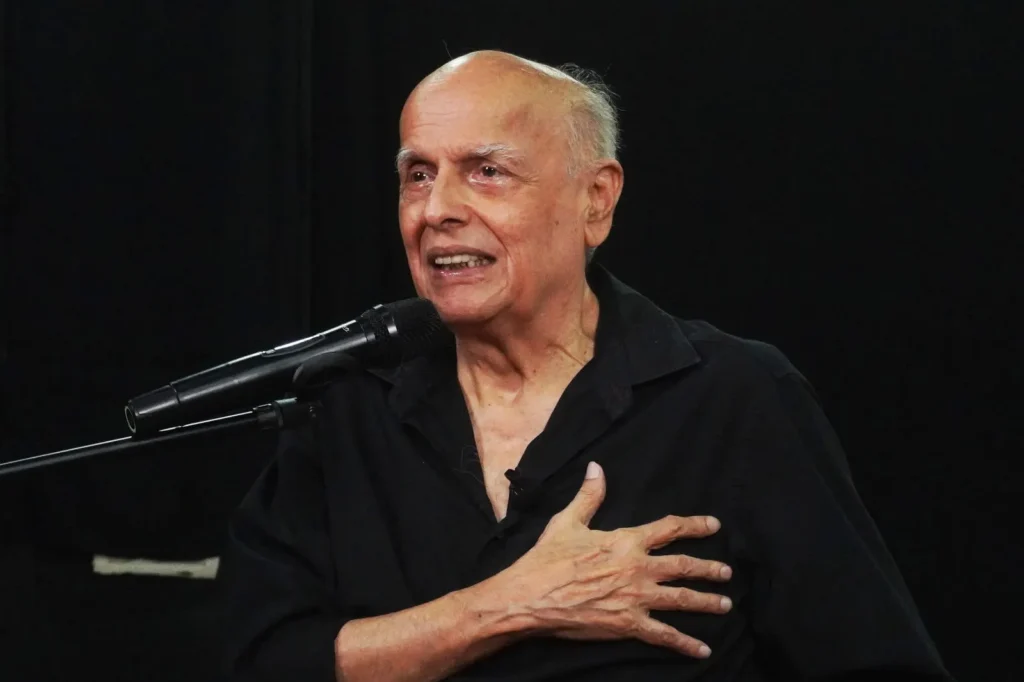
Even as big-budget spectacles command attention and entertainment streams endlessly into our homes and phones, theatre’s intimacy remains irreplaceable. Recently, actor Pooja Bhatt messaged her father, filmmaker Mahesh Bhatt, awestruck by Naseeruddin Shah’s performance in "27 Seconds," an adaptation of Salman Rushdie’s autobiographical “Knife,” at the Prithvi Theatre Festival. For Bhatt, a regular at Prithvi since its early years, it stirred memories of Satyadev Dubey, Amrish Puri arriving on his scooter, and his first glimpse of Soni Razdan. Nearly 48 years later, his fascination with the stage and the actors who inhabit it, remains undiminished.
Your deep connection with theatres continues to this day. How did that start?
Theatre has been part of my life for decades. We looked forward to going to Prithvi Theatre. You watched a play, sat in the café, met actors and writers. There were young people with very little money and an enormous appetite for work. I loved being around them. I also feel you must turn up for people whose work you value. Theatre needs an audience. If my presence gives an actor, writer or director some encouragement, I am happy to be there.
What is it about theatre that draws you to it?
I love actors. Finally, whatever story I want to tell, I need a human being to express it. The body, the voice, the gesture – these were our tools long before the camera arrived. Through them, you could express love, dissent, outrage. You could make people question the world they were living in. Think of Genet, Camus, our own great playwrights. Ritwik Ghatak was passionately involved in theatre. As a filmmaker, I am fascinated by what an actor can do before a live audience. I can cut, change the angle, ask for another take. Onstage, the actor has to carry the evening through. At Prithvi Theatre, you are close enough to notice the smallest movement. You find yourself listening very carefully. I also admire Makrand Deshpande’s attachment to theatre. For him, it is an end in itself. He isn’t waiting for a film offer. This is what he wants to do with his life.
Related Stories

When did this romance begin?
With Satyadev Dubey. He was a giant, a maverick. There was nobody quite like him. Most of the plays I watched in those early years were his. When Prithvi opened in 1978, I was going through a turbulent period. I was a director who felt dead on arrival. A string of flops in my twenties. “Arth” was still to happen. Before that film happened, life happened to me and shattered me.
Those were the years when Prithvi became my classroom. I remember Amrish Puri arriving on his scooter with a sidecar after his day’s work. He would park it, go in, and then appear onstage. I can still see him arriving. And then I remember the force of that man as an actor. I rubbed shoulders with Akash Khurana. I met Makrand there. So many of my associations with actors began in that world. I also saw Alyque Padamsee’s “Jesus Christ Superstar” and “Evita.” Stunning productions. Dubey achieved so much with very little. Alyque’s productions were as lavish as theatre could get. I was fortunate to experience both.
Who are your play-watching companions?
Pooja (Bhatt, his daughter) loves theatre. She watches plays and tells me what I should see. Recently, she messaged me after watching Naseer in “27 Seconds.” She was awestruck. I am looking forward to seeing it myself. Soni (Razdan, his wife) has her own long association with the stage. She has rehearsed, performed and traveled with plays. She knows the work that goes into an evening we sit down to enjoy. The first time I saw her was in Dubey’s “Band Darwaze,” based on Sartre’s “No Exit.” Here was this not-so-Indian-looking girl wrestling with Hindi, and I couldn’t take my eyes off her. She was mesmerizing. After the show, I saw her from a distance. We didn’t meet then. Whenever I think of that first glimpse of Soni, I think of that play and Prithvi.
Which plays and performances have stayed with you?
Naseer in “Waiting for Godot” at Prithvi. That was one of the most profound experiences I have had in a theatre. It has left an indelible mark on me. Then there is Nilu Phule in “Sakharam Binder.” Vijay Tendulkar’s “Shantata! Court Chalu Aahe” and “Ghashiram Kotwal.” Innumerable Dubey productions. I cannot recall every title now, but I remember what I felt watching them.
Anupam’s “Kuch Bhi Ho Sakta Hai” was a pathbreaking one-man show. He took [episodes from] his own life, including his failures, and brought it to the stage. He has kept performing it for years. His recent production, “Jaane Pehchaane Anjaane,” has had a wonderful response in India and America. I haven’t seen it yet, but I am dying to.
Juhi Babbar deserves a special mention. She has done so much work in theatre, acting and directing. I have seen two of her productions. The personal, autobiographical work she developed with Makrand’s help affected me. She has a voice of her own. I would like more people to see her work.
“7:40 Ki Ladies Special” moved me deeply. It drew on Pooja Sharma’s journey from Kolkata to Mumbai, joining the kinnar community and finding recognition through her dancing on the local trains. Here was a newcomer bringing her own life onto the stage. I traveled with the production and gave it whatever support I could. These are experiences I carry with me. And there is still so much I want to see.
Popular on Variety
Who are your favorite theatre actors?
Amrish Puri and Nilu Phule are unforgettable for me. Naseeruddin Shah, Anupam Kher, Paresh Rawal, Swaroop Sampat, Makrand Deshpande, Juhi Babbar. And Soni, of course.
I admire their continuing need to perform. Some have had enormous success in cinema, but they return to rehearsals and take their plays from city to city. They still want that encounter with an audience. I understand that attachment.
Have you ever considered directing a play?
I would have to learn. Being a film director doesn’t automatically equip you to direct for the stage. My involvement has been in supporting work I believe in. “The Last Salute” was a very important experience. Arvind Gaur directed it, drawing on the account of Muntadhar al-Zaidi, the Iraqi journalist who hurled his shoes at George W. Bush. We wanted people to hear about the Iraq behind that incident. The deaths, the suffering, the ordinary lives destroyed by war.
We did more than a hundred shows. I would open the performance by reading the letter I had written declining an invitation to the National Prayer Breakfast with President Bush. That set the tone. I gave the production my time and traveled with it because I felt strongly about what it was saying. I wanted to help those actors get the story heard.
Have you persuaded your children to accompany you to plays?
Pooja needs no persuasion. She has her own love for theatre, particularly Prithvi. Shaheen and Alia haven’t developed the same habit. Alia saw a few plays in her formative years, sometimes on her mother’s strong recommendation. But the affection has to become your own. For me, Prithvi holds so much of my life. I go every November to remember the people who made it possible. Shashi and Jennifer (Kapoor) built it in memory of Prithviraj Kapoor. Here was a family we call cinema royalty, and they gave other people a stage. Kunal, Zahan and Shaira (Kapoor) continue to look after it with such care.
I think of the young actor who comes there hoping someone will notice him. I also think of the older actor whom people are beginning to forget, still holding on fiercely to the need to act. Prithvi has room for both. That is an extraordinary gift to leave behind. You give people a place to do the work they love. Nearly 48 years later, someone is rehearsing there, someone is waiting to go on, and an audience is gathering outside.












Comments are moderated. They may be edited for clarity and reprinting in whole or in part in Variety publications.