



Aug 09, 2026 3:18pm IST
news-old-title
Naseeruddin Shah, Gurvinder Singh Turn a Village’s Real Grief Into Locarno Competition Title ‘Rehmat’: ‘It’s Important That These Films Get Made’
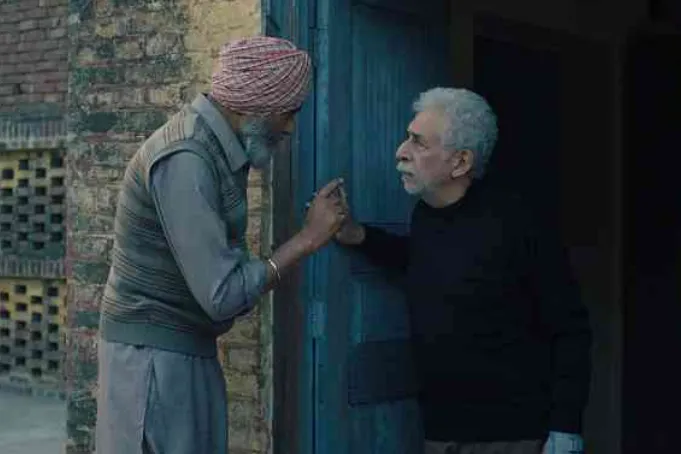
The family living in the house that “Rehmat” uses as Rashid Ali’s ancestral home lost a son to a drug overdose shortly after Indian filmmaker Gurvinder Singh and his crew first met them.
Singh tells Variety, “The actual family that lives there lost their 19-year-old son after we met them for the first time. When I looked at him, the first thought that ran in my mind was that he was on drugs. And he died of an overdose within two months. What else do I need to say? How can that not affect you as a filmmaker planning a film in that scenario. How can you avoid depicting such a state of affairs?”
“Rehmat” has its world premiere in the Concorso Internazionale, the main competition of the 79th Locarno Film Festival. It is the only Indian feature in the section this year and will compete for the festival’s top honor, the Pardo d’Oro.
Adapted from short stories by the Punjabi writer Ajeet Cour, “Rehmat” weaves three narratives set in present-day Punjab around themes of displacement and inherited grief. Singh says the material resonated with him directly through family history. “She has written about many themes, uprootedness being one of them, and she belongs to my grandparents’ generation that migrated from Lahore or other parts of west Punjab to Delhi,” he says. “That was the sort of affinity I had with her stories.”
Three decades after he began documenting Punjab’s folk ballads and oral histories, and 15 years after his debut feature “Anhey Ghorhey Da Daan” premiered in Venice, Singh says the film has given him something he didn’t expect. “I never experienced the Partition, but did feel a sense of trauma during the years of militancy and the anti-Sikh carnage in Delhi in 1984,” he says. “Frankly speaking, this film offers me a closure. I feel it has brought out all that I needed to express about the divided land and its people.”
The film stars revered Indian thespian Naseeruddin Shah as Rashid Ali, a Punjabi Muslim man whose family left before Partition and who returns to his birthplace after a lifetime in England. Shah says he committed to the role before knowing any of its specifics. “I’d seen and been deeply moved by Gurvinder’s films,” Shah tells Variety. “His cinematic sensibility and his take on the turmoil in his home state made profound statements. I just thought I’d like to be part of such films.”
That leap of faith went both ways. Singh says, “I approached Naseer without having written the script, only having a vague outline of the character of Rashid in my mind. His acceptance gave me the possibilities to expand and flesh it, knowing the kind of conviction, intellect and charisma he will bring into it. The responsibility became a flight of imagination. It was a new territory for me.”
Of working with Shah on set, Singh says, “I had decided that I would initially observe him in front of the camera and then figure out my approach. But I kept doing that and hardly needed to direct him,” describing how the actor’s “use of the body, gestures, handling of objects” turned Rashid “into his own personal expression.”
Shah, who is not Punjabi and does not speak the language fluently, says, “I agree I don’t have the Punjabi heartiness and I don’t look Punjabi. But I think that helped to identify Rashid as an outsider. I don’t speak Punjabi fluently but practice helped.” On the ambiguity of a character who initially introduces himself to the village as God, Shah adds: “A character doesn’t have to be understood by the actor playing him. Actors aren’t psychoanalysts. One must be able to empathize with the character’s situation.”
Singh’s preference for long, unbroken takes runs through the film, including the opening shot that establishes Seema’s world. Singh says, “The sense of uninterrupted time that the long take affords, both with the static and the mobile camera, is highly involving for me as a spectator, and my first instinct is to attempt that. But there are scenes where you know it will not be practical or even desirable, hence the montage has to be employed. Both create a different quality of attention and being. And perhaps life is also like that. Our ways of seeing and engaging keep altering.”
Shah adds, “I love long takes. It fits beautifully with my stage work. Frankly I don’t believe there’s a great difference between stage and film acting if truth is what you’re looking to find.”
Beyond the ancestral house, Singh says the village itself, with its crumbling 19th-century school building and untended lanes, reshaped the narrative during location scouting. Asked how he views Punjab today, Singh says, “Bleak from the perspective of lack of imagination among the youth or those of my generation, not because of any lack of compassion. People are sticking to the glory of ownership of land and the caste they belong to. It has given them a false sense of bravado and entitlement. And the gender discourse is abysmal, especially in the villages. No wonder so many young girls are escaping to the West.”
Alongside Shah, the cast includes Suvinder Vicky, Mita Vashisht, Navjot Randhawa and Diya Kamboj, plus the celebrated Punjabi poet Jaswant Zafar, making his screen acting debut at 60 as Harjap. Of casting Zafar, Singh says, “Whenever I have cast a non-actor in a major role, it is fully knowing that the person will play himself or herself on screen. So Zafar became Harjap for me. He has all the natural qualities I had imagined in Harjap and a profound sense of the feelings that he carries, both as a common man and as an intellectual.”
“Rehmat” is produced by Singh and Arpana Caur, with Andrei Cosmin Illes and Némésis Srour serving as co-producers. The film is a co-production between India’s Vahao Studio and Paris-based Pavo Films, the outfit Illes and Srour launched earlier this year, with “Rehmat” as its debut project.
Shah, whose career stretches back to the parallel cinema movement of the 1970s, says, “My early work prepared me for a film like this. I think Gurvinder has surpassed other contemporary filmmakers in India.” Of the film’s Partition-era subject matter, he says, “I believe it’s important that these films get made. Even if not widely seen now, they will remain as a testament.”
Asked what he’s working on next, Singh says, “I am not sure what I want to do after this. I came to the cinema through some conspiracy of the universe. I grew up painting and writing. I am painting again these days.”









Comments are moderated. They may be edited for clarity and reprinting in whole or in part in Variety publications.