



Nov 06, 2026 3:26pm IST
‘Mookuthi Amman 2’ Review: Nayanthara’s Divine Outing Gets Lost in a Maze of Masala and Chaotic Storytelling
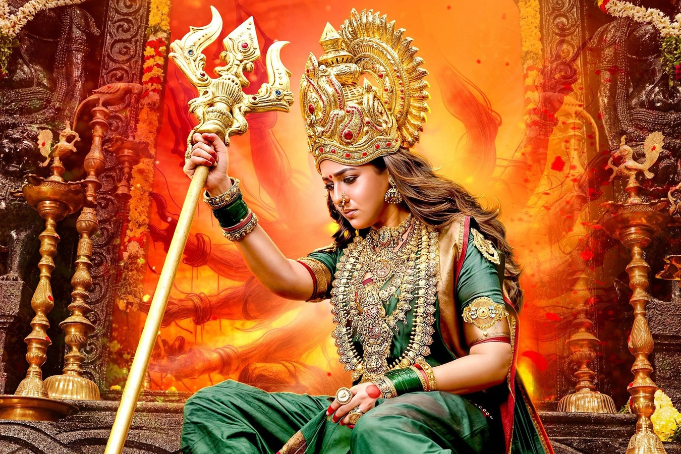
There was a certain freshness to “Mookuthi Amman” (2020). At a time when devotional films largely followed familiar storytelling templates, RJ Balaji’s film found an interesting way to question blind faith, expose the exploitation of religious beliefs and take potshots at self-proclaimed godmen. It did so with humor, a contemporary sensibility and an upbeat narrative that never lost sight of its entertainment quotient. The film had commercial ingredients, but it also had something to say. More importantly, it knew how to say it without becoming preachy.
The sequel, however, appears to have left much of that sensibility behind. With Sundar C replacing RJ Balaji as director, “Mookuthi Amman 2” undergoes a significant change in both tone and treatment. Sundar, whose filmmaking vocabulary is steeped in commercial masala, brings his signature ingredients into the franchise. The result is a film that seems unsure of what it wants to be: a throwback to the 1990s Amman films, an Indiana Jones-style supernatural adventure or a divine spectacle designed to capitalize on the current appetite for mythology-driven cinema, particularly in the wake of Kantara.
The premise certainly has potential. With Nayanthara returning as the titular goddess, the film takes the franchise into a more elaborate supernatural territory, involving mysterious visions, an ancient village, divine forces and a battle against powerful adversaries. There is an attempt to build a larger mythology around the character and create an adventure that goes beyond the relatively grounded social satire of its predecessor. The ambition is evident, but the storytelling is not quite equipped to handle it.
Related Stories

The biggest problem is the film’s inability to settle on one narrative direction. Just when a particular thread begins to develop, another character, revelation or conflict is introduced. There are multiple villains, parallel tracks, supernatural interventions and several twists that are meant to bring everything together. But the screenplay’s idea of cleverness often rests on convenient coincidences. The way clues fall into place and characters connect with one another has the almost effortless logic of an Enid Blyton children’s detective novel, where every mystery conveniently finds its answer at just the right moment. What could have been an engaging adventure ends up feeling like a collection of plot devices waiting to be connected.
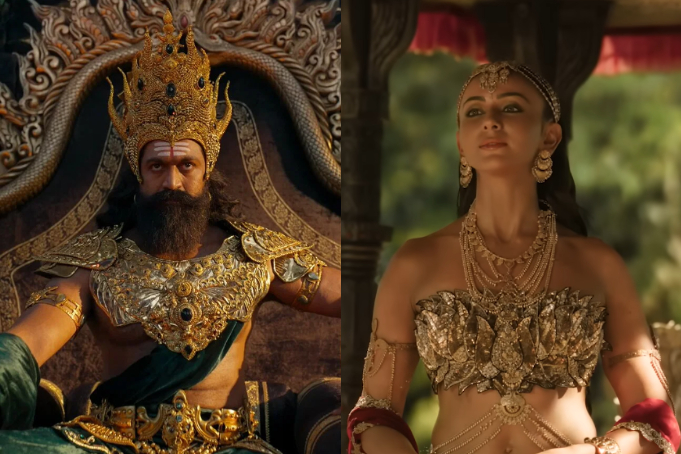
Sundar C clearly wants to make this a much bigger film, and the casting reflects that ambition. Apart from Nayanthara, the film brings together an extensive ensemble that includes Regina Cassandra, Duniya Vijay, Garuda Ram and Sunil, along with familiar faces such as Khushbu Sundar and Sneha in cameos. Urvashi and Yogi Babu add their respective comic and emotional dimensions to the proceedings. There is even a CGI Satan in the mix. It is quite an assortment of characters and performers, but the film seems more interested in assembling a formidable cast than in giving each of them a meaningful place in the narrative. The multiple antagonists, in particular, rarely translate into the kind of tension or dramatic escalation the story needs.
Nayanthara, fortunately, remains one of the film’s few consistent strengths. She brings the authority and composure that the titular character demands, and there is an effortless command to her screen presence. She looks comfortable inhabiting the divine space, even when the material around her becomes increasingly chaotic. Given her stature and the popularity of the first film, she deserved a much stronger vehicle. The problem is not with the performer but with a screenplay that repeatedly lets her down.
The comedy, another familiar Sundar C staple, also struggles to find its rhythm. The original film’s humor emerged organically from its social commentary and its understanding of contemporary behavior. Here, comic stretches often feel like obligatory interruptions between dramatic sequences. The film moves between humor, horror, fantasy and devotional drama without establishing a consistent tonal identity. The result is an experience that is neither particularly funny nor sufficiently absorbing as a supernatural adventure.
Popular on Variety
But the most glaring letdown is the visual effects. A film that wants to sell divine interventions, supernatural confrontations and elaborate fantasy sequences has to first convince its audience of the world it is creating. Unfortunately, the effects are so unconvincing that several sequences lose their intended impact even before the drama has a chance to register. The artificiality is particularly disappointing in a film that clearly wants to be experienced as a spectacle. The background score frequently tries to compensate with heightened musical cues and volume, but sound and scale cannot always disguise the limitations of what is on screen.
It would be unfair to suggest that Sundar C hasn’t put in the effort. There is clearly an attempt to create a grander universe, introduce multiple layers of conflict and give the audience a full-fledged commercial entertainer. But this is also where the film’s fundamental problem lies. Everything is dialed up, from the number of villains and cameos to the supernatural elements and comic diversions. There is little understanding of when to hold back. Restraint is not the absence of ambition; sometimes, it is what gives ambition its shape.
With Nayanthara leading the proceedings and the first film already having earned a place among audience favorites, “Mookuthi Amman 2” should have been a much more rewarding outing. Instead, it settles for a middling experience, one that has the ingredients for a big entertainer but lacks the conviction and craftsmanship to bring them together.
For a film that invokes divine intervention at every turn, perhaps the one thing it needed most was a little divine restraint. Because when everything is made into a spectacle, very little actually feels spectacular.










Comments are moderated. They may be edited for clarity and reprinting in whole or in part in Variety publications.