



Jan 31, 2026 9:30pm IST
Real Kashmir Football Club Review: Finding Purpose where Cinema Finds Conflict
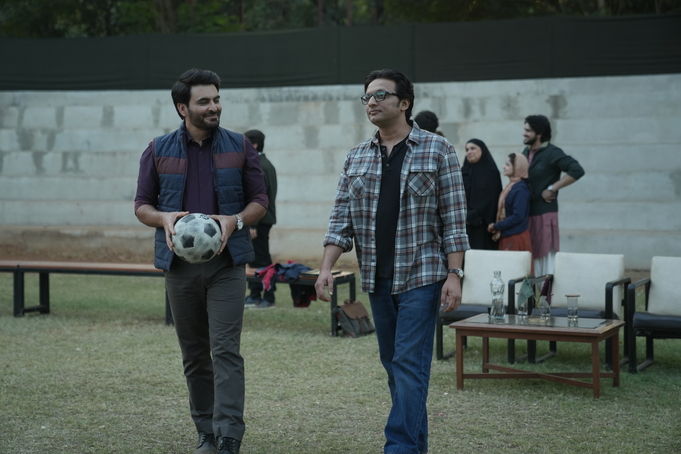
The Indian streaming space for years has seen Kashmir through either gunfire or grief, and the lens hasn’t been cleaned for a very long time. Probably that is why SonyLIV thought it was not just a better idea to clean it, but also shift the focus to a Kashmir that is beyond grenades, border wires, and the snow where chiffon flows and lovers unite. Real Kashmir Football Club trades all of it for football, and the bait is quite interesting because people come alive, and so does the landscape that at this point is only associated with melancholy.
Set in a valley long flattened into headlines and talking points, the gaze shifts from conflict to consequence, from symbols to people, and it is such a relief. It opens not with speeches or spectacle, but with boys negotiating suspicion as casually as they discuss the weather. Most cinematic exploration before this has often been carried out through an outsider’s gaze, one that limits access and rarely feels welcoming. Scratch the surface, however, and there are stories of hope waiting to be told. Grounded stories of people who find purpose in a place that shows and films usually associate only with darkness and despair.
Real Kashmir Football Club stands firmly on the side of those stories. It is a show that does not want to look at borders or headlines. It wants to look at Kashmiris. More importantly, it does not treat them as documentary subjects with flushed faces narrating their suffering for effect. Instead, it presents them as people living their lives, shaping meaning around the barriers imposed by their circumstances. Directors Mahesh Mathai and Rajesh Mapuskar, along with a writing team that includes Simaab Hashmi, Danish Renzu, Umang Vyas, Chintan Gandhi, Adhir Bhat, and Dhruv Narang, build an underdog narrative that uses familiar tropes of the genre while also imprinting a distinct identity on it. That effort to personalise the formula is what truly matters here.
The last time Indian cinema saw a filmmaker fully use the devices of a sports underdog drama while reshaping the genre was Nagraj Manjule with Jhund. In that film, the redemption arc was never about winning on a grand international stage or playing in front of packed stadiums. The real victory lay in the boys from marginalised communities simply being able to board a flight. The struggle existed long before the whistle blew. That is what made Jhund resonate so deeply.
The Real Kashmir Football Club borrows from that blueprint, but roots it even further in its geography. In Kashmir, the boys need more than just a team or a trophy. They need purpose. For viewers unfamiliar with the story, the show is based on real events involving two men Sandip Chattoo and Shamim Meraj who went against the odds to establish Jammu and Kashmir’s first football club capable of competing in India’s top tier league.
Related Stories

The screenplay treats football as a lifeline rather than a spectacle. After a devastating flood, two years of disruption, and intense political unrest in Srinagar in 2016, unemployment has reached alarming levels. For some players, the modest salary of Rs 10,000 attached to the game, represents survival. For others, it is the fulfilment of long-held dreams. For one young man, it becomes a path back home. The emphasis remains firmly on the struggle to even reach the ground, rather than what happens once they are on it.
What the writing does particularly well is capture the unrest of the valley in brief, measured moments. It repeatedly reminds the viewer that the journey to build this club is fraught with challenges far more intense than what most audiences are likely experiencing from the comfort of their homes. These reminders never feel forced. They exist as a constant hum beneath the narrative.
One of the show’s biggest strengths lies in its refusal to shout out its politics. The screenplay trusts its audience to be informed and attentive. It addresses some of the most painful chapters in the region’s history, including the exodus, stone-pelting, and the systematic brainwashing of the youth, without explicitly naming or pointing fingers. There is a sense of restraint that feels rare and refreshing.
Perhaps most striking is the normalisation of co-existence. Shirish, a Kashmiri Pandit (Manav Kaul) and Sohail, a Kashmiri Muslim (Mohammed Zeeshan Ayyub) are business partners and friends. Their wives acknowledge each other’s presence and contributions with quiet respect. None of this is underlined or explained. It simply exists, mirroring real life more closely than most cinematic depictions of the region have managed to do in recent years.
Somewhere in episode six, a key scene captures a silent yet powerful revolt. A group of Kashmiri boys, tired of constantly being viewed with suspicion, fight with a police officer for holding them back but not others because these boys belong to a certain community. They are arrested and the fear looms that the police will be brutal to them. Moments later, when a man who happens to be a Kashmiri Pandit (Manav Kaul) steps in to save them, Amaan (Abhishant Rana), a boy who has been supporting a local politician and spreading hatred, is confronted with a reality he has never allowed himself to see. It takes courage to tell a story like this in the current climate and both directors, along with the SonyLIV executives who backed the project, deserve credit for allowing such a voice to emerge.
Popular on Variety
The performances further elevate the material. They feel deeply personal, as though the actors are invested in more than just their roles. Manav Kaul, who belongs to the community he portrays, brings an aching authenticity to Shirish. When the narrative revisits the trauma of the exodus through his character, the weight of lived memory is unmistakable and devastating. Mohammed Zeeshan Ayyub delivers one of his most controlled performances to date. As Sohail, he appears effortless, almost as if he is not acting at all but simply existing within the frame.
The younger cast members are equally compelling. Their faces carry a palpable sense of aimlessness that perfectly aligns with the show’s central theme of searching for direction. This collective uncertainty lends emotional credibility to their eventual transformation.
That said, The Real Kashmir Football Club is not without its flaws. The narrative occasionally takes abrupt leaps between scenes, creating gaps that momentarily disrupt the storytelling flow. After the fourth episode, the show begins to circle familiar territory. The friction between the coach and the star player, the clashes of ego, and the ensuing conflicts start to feel repetitive. The introduction of a foreign coach leads into a training montage that feels oddly placed and predictable. From this point on, the trajectory becomes easier to anticipate.
However, redemption arrives in the way the creators choose to conclude the season. The journey depicted is long, difficult and far from complete. What is achieved by the end may only be the first step, but its significance cannot be overstated. Eight episodes earlier, these boys were merely existing, disconnected from any sense of consequence. By the finale, they have become participants in their own futures, standing at a safe distance from the negativity that once threatened to consume them.
The show silently poses important questions. Perhaps employment is part of the solution. Perhaps nurturing dreams and acknowledging passion can act as powerful counterforces to despair. Maybe this is how Kashmir finds its way back to a version of glory that carries no propaganda, no agenda, and no imposed narrative.
This is not a sports drama chasing trophies or triumphalist emotion. It is a grounded, gently subversive story about purpose, dignity, and what it means to belong in a place rarely allowed to just breathe.
The Real Kashmir Football Club does not claim to have all the answers. What it offers instead is something far more valuable. A humane, grounded, and empathetic gaze that allows Kashmir to breathe, not as a symbol, but as a lived space filled with people striving for purpose.
Real Kashmir Football Club is now pemiering on SonyLIV.














Comments are moderated. They may be edited for clarity and reprinting in whole or in part in Variety publications.