



Nov 12, 2026 10:00pm IST
‘Ramayana’ Production Designer Subrata Chakraborty on Building Ayodhya and Lanka: ‘We Wanted Viewers to Be Unable to Tell What Was Set and What Was VFX’ (EXCLUSIVE)
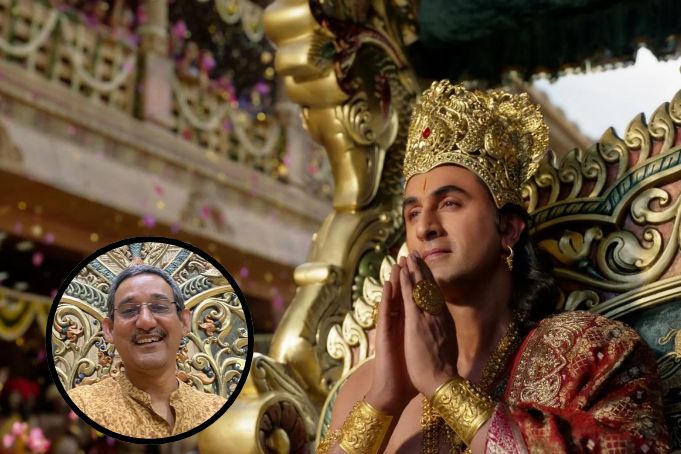
Building the world of “Ramayana” was a three-year commitment that pushed Indian production design into unfamiliar territory. For production designer Subrata Chakraborty, who worked alongside his creative partner Amit Ray, the challenge was to build an immersive visual world where physical sets and visual effects could seamlessly come together.
In an exclusive conversation with Variety India, Chakraborty opens up about the scale of the undertaking, the extensive research behind the film's architecture, and how the team adapted an existing visual blueprint developed by Oscar-winning production designer Ramsey Avery to give the world a distinctly Indian identity.
Related Stories
Western Blueprints to Indian Architecture
The project had already been in development for over five years when Chakraborty and Ray came on board. The initial design process involved an international team of Hollywood artists who had been working with director Nitesh Tiwari, producer Namit Malhotra and other collaborators. However, when the duo reviewed the existing designs, they felt that the visual language leaned towards a Western aesthetic. "Basically, what we felt was that it was more of a Western drawing. We are artistes. We decided to Indianise the designs when we took up the project. The production designers from abroad were humble. They were okay with us Indianising the designs," Chakraborty recalls.
The designers went back to research, drawing from Indian architectural traditions and historical references to reshape the visual language. He adds that the team also explored Asian architectural influences from Sri Lanka and other locations.
However, adapting the designs was only one part of the challenge. Chakraborty admits that the technology and workflow required for a project of this scale were initially unfamiliar to his team. He eventually approached Malhotra for guidance, following which Ramsey Avery, the Oscar-winning production designer who had worked on the project during its earlier development, came on board to mentor them.
Avery helped the Indian team understand the Hollywood approach to world-building, where production design, visual effects and cinematography are integrated from the earliest stages rather than treated as separate processes. They familiarized themselves with software such as Blender and the use of 3D models and textures.
Making Ayodhya and Lanka's Distinct Visual Worlds
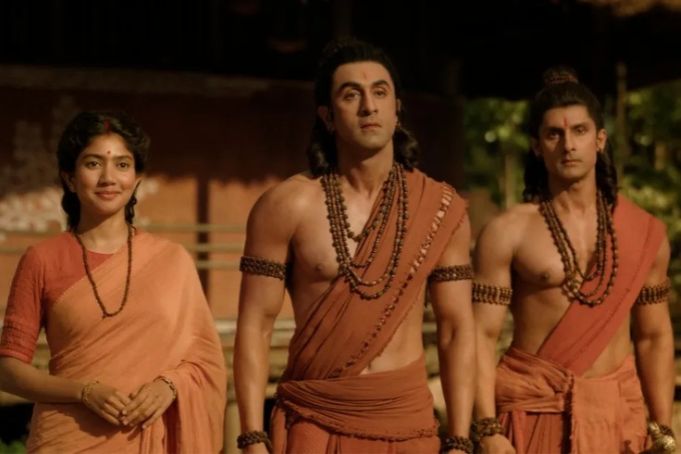
The production design also involved rethinking the architecture of the film's various kingdoms. While Avery's initial designs provided the foundation, Chakraborty and Ray introduced changes to give the locations a more rooted identity. For the Pushpak Vimana, for instance, the earlier design was largely retained, with the Indian team making select alterations. For other parts of the film, they drew from Indian architectural traditions, including the Sun Temple at Konark, as well as Southeast Asian architectural influences.
He further clarifies that the team's interpretation of Lanka was not limited to contemporary Sri Lankan architecture. "To build Janasthan, we used aesthetics from Cambodia and a few other Southeast Asian references from in and around the countries of Sri Lanka," he shares.
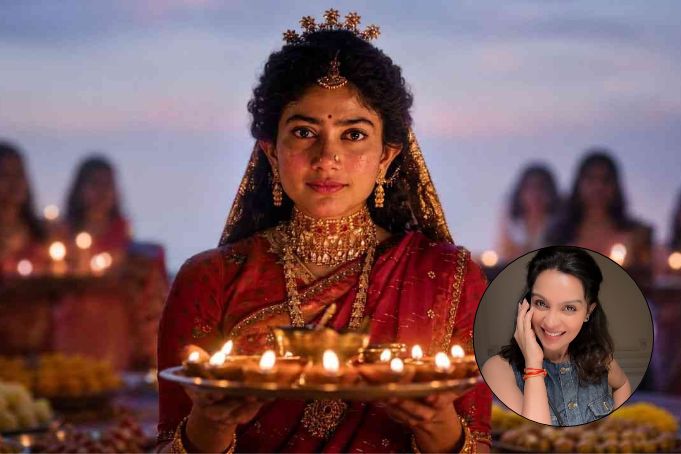
Ayodhya and Lanka, meanwhile, were conceived as contrasting visual worlds. According to Chakraborty, the biggest difference between the two was their colour palette and the atmosphere they needed to communicate. "From the director's point of view, Ayodhya was very important. He said Ayodhya should be calm. There should be coolness in the colours, with plenty of opulence. It has to look beautiful visually," he recalls. "Lanka is like an ego. That is the contrast."
Behind Dasharath's Chariot and Shiva's Bow
Among the more demanding builds was Dasharath's chariot, which required nearly one-and-a-half months of work on its chassis and engineering alone. Chakraborty says that although he had designed chariots before, he had never attempted something of that scale.
Recalling the sequence involving Shiva's bow in Mithila, he explains that the enormous object could not realistically be carried by a handful of people. Following research by associate production designer Pallavi Petkar and the team, they incorporated a platform supported by a structure that allowed the bow to be transported and temporarily placed during the event.
Blending Physical Sets With VFX
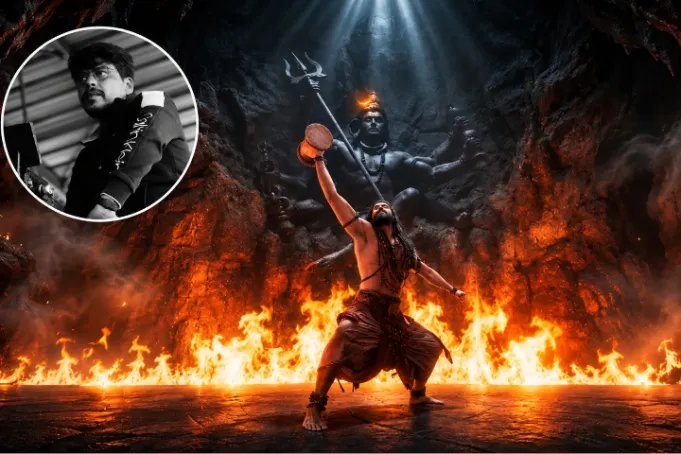
One of the most important aspects of the production design was ensuring that the physical and digital environments felt like one cohesive world. The proportion of sets and VFX varied depending on the sequence. The throne room in Ayodhya, for example, was approximately 70 percent physically constructed, with the remaining 30 percent created through VFX. The courtyard sequence featuring a dream about Dasharath's death was also largely set-based, with around 70 to 80 percent of the environment physically built.
The balance shifted considerably for the action sequences. The fight in Lanka was approximately 30 percent physical sets and 70 percent VFX, while ‘Rasatala’ used an almost equal combination of both. The Pushpak Vimana, too, was predominantly digital, with only around 10 percent physically constructed.
He explains, "The good thing is people are confused about what physical sets are and where we used VFX. We wanted viewers to be unable to tell what was set and what was VFX. That is a huge thing for us. That is a huge thing for us."
‘‘Ramayana’ is a Mathematical Film’
He also pointed to the technical precision required to achieve that seamlessness. Working with green screens, digital environments and large-scale action sequences meant that every physical element had to be positioned with mathematical accuracy. "We had to work against green screens. We had to understand how to enhance the forest and how it would blend with our design. We didn't know where to put the elements, how to create the texture or how much to slide," he says, describing the challenges of designing environments for action sequences.
Popular on Variety
Chakraborty adds, "It was a mathematical film. If the mathematics was even a little off, the VFX would be off. That's why VFX can look fake. We had to make everything mathematically accurate so that when the VFX was created after our work, it would look real."
For Chakraborty, “Ramayana” was a project in which every sequence presented a different challenge, particularly because it required an Indian production design team to adapt to a scale and technological process they had not previously encountered. But the collaboration also gave them an opportunity to combine traditional artistic skills with a more Hollywood-style approach to filmmaking.





Comments are moderated. They may be edited for clarity and reprinting in whole or in part in Variety publications.