



Mar 06, 2026 10:00am IST
Oscar-Nominated Director Geeta Gandbhir on ‘The Perfect Neighbor,’ Documentary Funding And Why “Distribution Is the Real Bottleneck” (EXCLUSIVE)
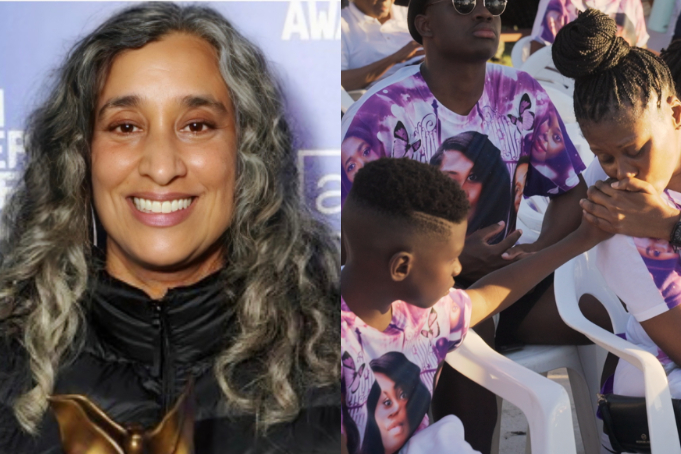
Geeta Gandbhir’s documentary "The Perfect Neighbor," currently streaming on Netflix is nominated at the 2026 Oscar Awards under Best Documentary (Feature) category. Based on the 2023 killing of Ajike “AJ” Owens in Ocala, Florida the film is largely told through police body-camera footage reconstructing the events leading up to the shooting and its profound impact on the neighborhood.
In an exclusive conversation with Variety India, Geeta speaks about the challenges of making a documentary in today’s environment, how AI has seeped into the genre and the Oscar buzz on ‘The Perfect Neighbor’. Here are excerpts from the chat:
Of all the reactions The Perfect Neighbor got, which one has has stayed with you most?
The one that meant the most came from Ajike’s mother. I showed her the film before Sundance and told her it was her decision what happened next. We could release it, shelve it, or I could delete everything. It’s her daughter’s legacy. She watched it once and said it made her physically ill. Then she watched it again and told me she understood it as a piece of art and wanted more for her daughter’s legacy. She wanted the film to have purpose, so her daughter’s death wouldn’t be in vain.
She also shared something Ajike often said, including the last thing she told her, “Mom, you wait. One day the whole world is going to know my name.” It landed like a prophecy. It gave us clarity about the mission and what we needed to do in her absence, to try and create change in her name.
When you began shaping the story, what were your non-negotiables?
We knew we wanted to live inside police body-camera footage and build the entire world from it. That footage is complicated. It can criminalize vulnerable communities and people of color, and it’s often used to protect police. But it can also preserve events as they happened, especially when truth is contested.
What I saw in the footage was something the police didn’t mean to capture: an intergenerational, multiracial community taking care of each other, raising kids together. It felt idyllic, the kind of neighborhood where children play outside and someone is always watching out, where neighbors trust one another.
Then, over time, you witness how one outlier weaponizes racism, manufactures fear, and tries to weaponize the police. You also see how access to guns and Stand Your Ground laws embolden her. The film becomes a study in contrasts: the best of a community set against the worst impulses in a system. For me, it’s also about cumulative failures, systemic and societal, that led to this outcome. The footage allows viewers to experience that progression and arrive at their own conclusions.
Related Stories
Your work feels unflinching. Who shaped your sensibility as a filmmaker?
Spike Lee and Sam Pollard, who were mentors to me, are constant influences. Spike’s work refuses to let you look away. He insists we bear witness to discomfort, and he’s not interested in coddling an audience.
Sam Pollard taught me the importance of leading with humanity. The story has to be emotional and shaped with the same craft as scripted filmmaking. You should feel for documentary participants the way you feel for characters in fiction. If there’s a social-justice issue at the core, it should emerge organically through story and emotion, not slogans.
There are also films that have stayed with me over the years, like Yancey Ford’s "Strong Island", and Michelle Stevenson and Joe Brewster’s work, including "Going to Mars: The Nikki Giovanni Project." I’m always learning from filmmakers who understand how form can deepen truth.
Did you want viewers to simply observe, or to feel immersed?
Immersion was the goal. We wanted to build a narrative entirely through the footage so audiences feel like they’re in the neighborhood, almost like they’re part of the community. Body-cam perspective is inherently intimate. There’s no comfortable distance between the audience and what’s unfolding.
I also wanted it to be propulsive, to play with the tension and momentum of a scripted thriller, even a horror film. That was deliberate. Documentary can sometimes get dismissed as niche, or as something that only speaks to people already invested in the subject. I wanted a wide audience, not because the film needed to be “accessible,” but because the mandate of what we were trying to do demanded reach. And it connected to Ajika’s dream too.
How did you navigate the ethics of what to include, especially around grief?
We debated a lot. Some moments are extraordinarily painful, including the children learning their mother isn’t coming back. I wasn’t sure we should keep it in. But Ajike’s mother was unequivocal: “You leave that in.” For her, that scene is the true cost of gun violence, the grief, not just for the children, but for the entire community. She believed the world needed to see it. If her grandchildren had to live it, she felt the public could bear witness.
At the same time, we were careful about not showing too much of Ajike after she was shot. The world already sees violence against Black bodies replayed endlessly. We didn’t want to recreate the shooting or dramatize it, or turn her into an image of repeated harm. The grief, however, was part of the truth we had to confront, and her mother gave us clear guidance on that.
Documentary financing is a constant struggle. Is it easier now than it was a couple of years ago?
No. It’s harder. There’s been a major contraction in the film industry. Studios and streamers have cut back significantly. Documentary is the canary in the coal mine, we are boutique compared to the larger industry, so when the broader ecosystem catches a cold, we feel it immediately.
Filmmakers will always find a way to make the work. Documentary people are scrappy. They’ll chase grants, patch together support, and do what they have to do. The bigger bottleneck right now is distribution. Making a film is one hurdle. Getting it seen is another. That’s where the system feels broken, and that’s where people are trying to innovate the most.
Does success help the next project, or is it just lightning in a bottle?
A successful film can open doors, absolutely. When a streamer sees a win, it can translate into more appetite or more resources to acquire and fund work. In that sense, everyone can benefit when one film breaks through.
But it doesn’t magically fix the industry, and you can’t always replicate “lightning in a bottle.” What I do find hopeful is when a small, independently made film with a lean team finds its audience. It reinforces the idea that more of this is possible, and that’s meaningful for the field.
How do you think about AI’s impact on documentary?
It’s seeping into everything. The real question is: what are we using it for? There’s still so much unresolved, especially around labor and replacement. I was at an awards event recently and someone said, “AI cannot love.” It can’t feel passion or make intuitive, human decisions the way filmmakers do. AI isn’t going away, so the goal has to be regulation and responsible use, so it doesn’t harm livelihoods or flatten the creative process into something automated.
How has the family and community processed the film since its release?
Ajike’s mother has been central. We also shared the film with the community. It was viscerally painful for them, but they understood what we were trying to do. They supported it because they don’t want another community to go through this, and they wanted the story out in the world.
Her mother is also a person of faith. She believes Ajike has a hand in this, that the film is part of her will. Each new audience, each moment of recognition, reinforces that feeling for her that Ajika’s dream is being carried forward.
She’s also spoken to me about how isolating grief can be, and how shared sorrow eases the burden. In a way, the Netflix platform has given her a global community, people responding, grieving, and expressing outrage alongside her. For her, that sense of being seen has been genuinely helpful.



Comments are moderated. They may be edited for clarity and reprinting in whole or in part in Variety publications.