



Feb 08, 2026 4:52pm IST
‘Sabar Bonda (Cactus Pears)’ Review: Finds Queer Love Not in Protest, But in Presence
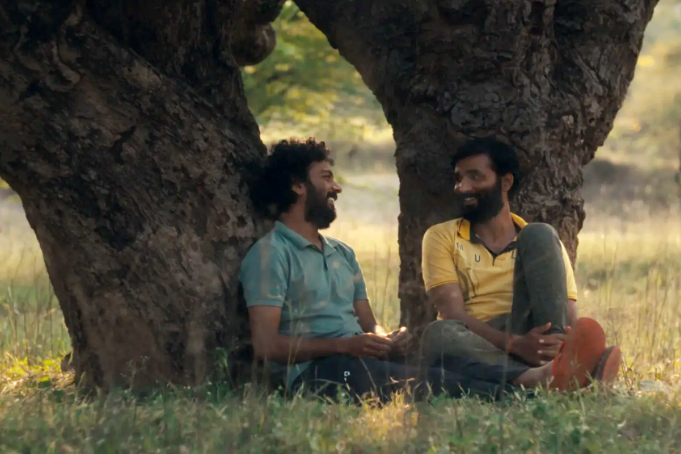
How often do you see two men falling in love on screen and being treated simply as humans living their lives, not specimens put up for exhibition where a loud, premeditated reaction is expected from the audience? Written and directed by Rohan Parshuram Kanawade, “Sabar Bonda” (“Cactus Pears”) is a semi autobiographical tale of a 30 year-old-man who is done fighting the world and now wants to exist on his own terms. But is the world ready to let him do that? In this melancholic story of finding love and trying to hold on to it, there is much more than what meets the eye. That is the magic that unfolds every time the camera lingers on two men waiting for the world to go silent so they can hear just each other.
Among the many coming out narratives, “Sabar Bonda” stands apart by moving beyond the act itself. This is not a film about revelation but about what life looks like after self acceptance, and what it means to be seen by the people who matter most. We meet Anand (Bhushaan Manoj) in an extreme close up as he prepares to take the mortal remains of his deceased father home. His mother (Jayshri Jagtap) stands beside him in the dimly lit hospital waiting area, where grief hangs heavy and unspoken. The body needs to be taken to their native village for the last rites, and it is there that Anand reconnects with Balya (Suraaj Suman), his childhood friend.
While Anand is recovering from heartbreak after the man he loved gets married, Balya, who is also queer, navigates his desire through emotionally detached flings with other closeted men in the area. Anand has become a city boy, carrying exhaustion and restraint in equal measure. Balya remains rooted to the countryside, waiting for affection that never quite arrives. Both men dodge pointed marriage questions and casual taunts, carving out a fragile refuge for themselves in a grazing ground far removed from the chaos of the mourning household.
Related Stories

“Sabar Bonda” is not just about two men falling in love, despite how many online narratives flatten it into that description. It is also about a man denied the space to grieve his father. Years of conditioning have convinced those around him that he does not need that space. Even wearing a black T shirt, a colour forbidden by his community, becomes reason enough to challenge his right to perform his father’s last rites. Kanawade writes “Cactus Pears” with a deeply personal gaze. The grammar of his debut feature feels rooted and lived in. You sense that this story has been observed closely, perhaps endured, because of how carefully it listens.
Ten days after the father’s death, cultural customs turn Anand’s life into a kind of prison. With no shoulder to lean on, he is forced into further isolation, allowed to meet only those approved by the family. There is a quiet, persistent melancholy in the way Kanawade and cinematographer Vikas Urs capture this world. Stationary frames dominate. Characters walk in and out of the frame while crucial moments unfold outside it. Sometimes you only hear what is happening, not see it, making you feel less like a spectator and more like someone present in the room. Anand’s claustrophobia and Balya’s yearning for freedom are captured with equal sensitivity. Kanawade allows moments to breathe long after the dialogue has ended.
The visual grammar of “Sabar Bonda” elevates an already strong screenplay. The initial awkwardness between the two men and the way the emotional distance between them narrows with each meeting is rendered with remarkable restraint. In a particularly tender moment, Balya finds a reason to touch Anand’s hair, gently combing it with his fingers. Kanawade and Urs frame only their eyes and foreheads, letting intimacy exist without intrusion. It is a fleeting moment, yet it stays long after the film moves on.
Kanawade also writes the mother with rare care. A woman dismissed as illiterate by her own father, she has spent her life confined to a cramped Mumbai chawl with a husband who has a good heart but struggles with alcoholism. While she nudges Anand to follow customs and avoid rebellion, she has accepted his queerness and supports him fully. Even when the entire room turns against him, she never abandons her son. Her presence grounds the film, offering quiet resistance within compliance.
Bhushaan Manoj delivers one of the most balanced performances in recent memory. He enters the film like a blank canvas and slowly fills it in. In a fleeting scene, he watches Balya bathe using the shampoo he has just offered him. Someone else is present, yet Anand’s gaze remains fixed, obsessive and vulnerable like that of a teenage boy. That vulnerability is quietly devastating. Suraaj Suman is equally effective as Balya, a man brave in private but not yet brave enough to come out. Kanawade ensures that vulnerability never tips into melodrama.
“Sabar Bonda” is a delicate film that traces the coming of age of two men as they figure out who they want to be and where they belong, without asking the world for permission. Queerness in “Sabar Bonda” is not an elephant in the room demanding acknowledgement or applause. It simply exists. That quiet confidence is what gives Rohan Parshuram Kanawade’s debut feature its uncommon power.
Read More About: Cactus Pears, Rohan Parshuram Kanawade, Sabar Bonda, Sabar Bonda Review
'Sabar Bonda (Cactus Pears)' Review: Finds Queer Love Not in Protest, But in Presence
Reviewed: Netflix, February 8, 2026. Running time: 112 MIN.
Production: (India-U.K.-Canada) A Lotus Visual Production. Producers: Neeraj Churi, Mohamed Khaki, Kaushik Ray, Hareesh Reddypalli, Naren Chandavarkar, Sidharth Meer. Executive producers: Ilann Girard, Kishor Vasant Sawant.
Crew: Director: Rohan Parashuram Kanawade. Screenplay: Rohan Parashuram Kanawade. Camera: Vikas Urs. Editor: Anadi Athaley.
With: Bhushaan Manoj, Suraaj Suman, Jayshri Jagtap. (Marathi dialogue)
















Comments are moderated. They may be edited for clarity and reprinting in whole or in part in Variety publications.